
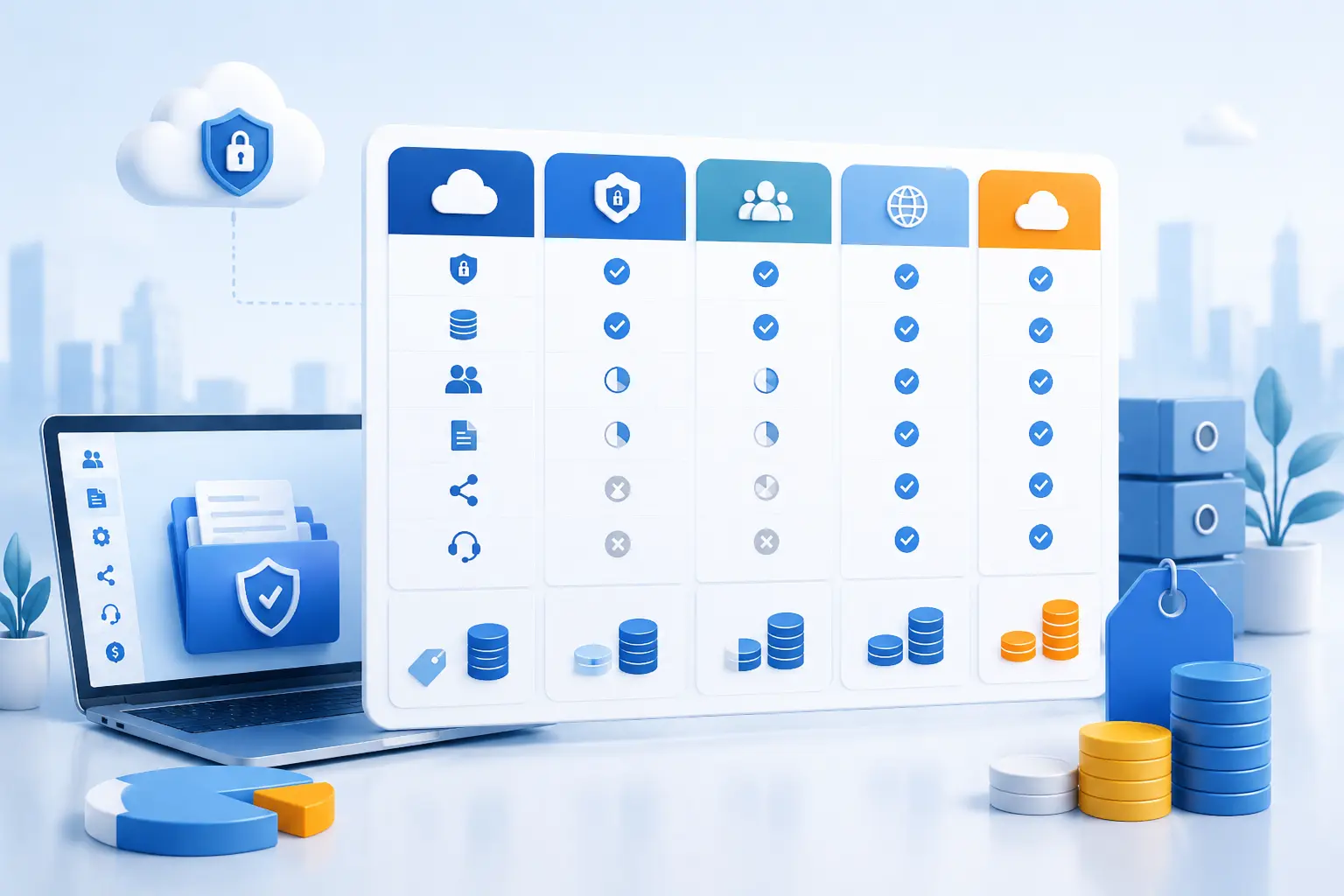
Quick answer: how much does a virtual data room cost?
Virtual data room pricing in 2026 depends on the provider, pricing model, storage volume, number of users, project length, support level, and security requirements. Some providers publish monthly prices, while enterprise VDRs usually require a custom quote.
As a general benchmark, lightweight secure-sharing tools can start below $100 per user per month. Dedicated virtual data rooms often start from several hundred dollars per month. Enterprise M&A data rooms are usually quote-based because pricing depends on deal size, document volume, number of bidder groups, support requirements, and compliance needs.
As a general rule, buyers will see three broad pricing categories:
For teams comparing virtual data room software, the best approach is to compare the full project cost rather than the monthly headline price. The most useful comparison includes storage, users, administrators, Q&A, redaction, support, project duration, archive exports, and renewal terms. To review EthosData’s current plans, start with the virtual data room pricing page.
What is virtual data room pricing?
Virtual data room pricing is the cost of using secure software for storing, organizing, sharing, and tracking confidential documents during business-critical processes such as M&A due diligence, fundraising, audits, legal review, real estate transactions, licensing, and corporate governance.
Unlike basic file-sharing software, a virtual data room usually includes deal-grade controls such as:
- granular user permissions
- document-level access control
- dynamic watermarking
- NDA or terms-of-access gates
- audit trails
- Q&A workflows
- download restrictions
- document analytics
- encryption
- multi-factor authentication
- role-based access
- buyer or investor activity tracking
- secure project archiving
These features explain why VDR pricing is usually higher than general cloud storage pricing.
Virtual data room pricing comparison by provider
The table below compares publicly available or officially described pricing models from major virtual data room and secure document-sharing providers. Prices should always be verified before purchase because many VDR vendors use customized quotes.
| Rank | Provider | Pricing transparency | Pricing model | Published pricing or pricing basis | Free trial or demo | Best fit |
|---|---|---|---|---|---|---|
| 1 |
Ideals Visit website |
Medium | Plan-based, storage-based, quote-based | Core, Premier, and Enterprise plans; pricing available by quote | Start free trial / get price | M&A, due diligence, fundraising, IPO, legal, enterprise deals |
| 2 |
EthosData, now part of Ideals Get a quote |
Medium | Project-scope and storage-based pricing | Pricing depends on project size, security needs, service needs, number of projects, admins, storage, support, and advanced functionality | Get price / start free trial | M&A, IPO, fundraising, private equity, compliance, litigation |
| 3 | Papermark | High | Flat-rate subscription pricing | Data Rooms plan from €99/month; Plus and higher plans available | 7-day free trial / start for free | Startups, fundraising, investor relations, diligence, secure document sharing |
| 4 | SecureDocs | High | Flat-rate pricing | Starts at $250/month for unlimited users and unlimited documents | Free trial available | Small and mid-market deals, fast setup, predictable pricing |
| 5 | Digify | High | Subscription tiers | Pro from $140/month; Team from $350/month; Enterprise custom | Trial/demo options | Startups, small teams, secure document sharing |
| 6 | ShareFile Virtual Data Room | High | Per-user pricing | Around $69.30–$77 per user/month, minimum 5 users | Try free | Professional services, legal, accounting, lighter VDR workflows |
| 7 | Ansarada | High | Storage-based pricing | Lowest published plan listed at $244/month for 250 MB on a 12-month term | Start free / online quote | Teams wanting published storage-based VDR pricing |
| 8 | Virtual Vaults | High | Plan-based, duration-based pricing | Published monthly pricing by plan and contract duration | Demo / online plan selection | European M&A, structured transactions, mid-market deals |
| 9 | Firmex | Medium | Single-project or subscription pricing | Quote-based; subscription recommended for more than one deal per year | Demo / quote | Repeat dealmakers, legal, diligence, compliance |
| 10 | ShareVault | Medium | Flat-fee pricing with storage and feature variation | Plans vary by storage and features | Demo / quote | M&A, life sciences, licensing, PE, legal teams |
| 11 | DealRoom | Medium | Deal-volume pricing | Flat-rate plans based on number of deals, with unlimited users and data storage | Demo / sales process | M&A lifecycle management and diligence workflows |
| 12 | Datasite | Low public pricing | Custom enterprise quote | Pricing customized for each transaction based on scope, requirements, and timeline | Demo / quote | Large M&A, investment banking, enterprise due diligence |
| 13 | Intralinks | Low public pricing | Custom enterprise quote | Pricing tailored by data volume, users, duration, and features | Demo / quote | Enterprise M&A, banking, private capital, regulated deals |
| 14 | Box | High for general plans, not VDR-specific | Per-user content management pricing | Published business content-management pricing | Free trial available | Secure content management, not a dedicated M&A VDR by default |
VDR pricing transparency comparison
Not every provider makes virtual data room pricing equally easy to compare. Some publish exact prices. Some publish plan structures without final prices. Others require a custom quote because deal size, storage, support, and compliance needs can vary widely.
Estimate Your Virtual Data Room Cost
This calculator uses illustrative example rates to give you a rough planning estimate. It is not a vendor quote and does not reflect any specific provider’s actual pricing.
Virtual data room pricing models explained
Virtual data room costs are difficult to compare because providers use different pricing models. The cheapest-looking plan is not always the lowest-cost option once users, storage, projects, support, and security features are included.
Storage-based pricing
Cost depends on data volume, usually measured in MB or GB.
Best for M&A, legal, due diligence, and projects with predictable document volume.
Project-based pricing
Cost is tied to one transaction, audit, fundraising process, or legal matter.
Best for One-off M&A, litigation, IPO prep, and asset sales.
Flat-rate pricing
Buyers pay one monthly or annual fee for a defined package.
Best for Budget-conscious teams and predictable projects.
Per-user pricing
Cost depends on the number of paid users or employee seats.
Best for Small teams with limited internal users.
Per-page pricing
Cost depends on the number of pages uploaded or processed.
Best for Small fixed document sets.
Enterprise quote-based pricing
Pricing is customized by scope, users, storage, support, security, and timeline.
Best for Large M&A, regulated industries, and global teams.
Deal-volume pricing
Cost depends on the number of transactions, projects, or active deal rooms.
Best for Corporate development and PE teams running multiple deals.
Where to compare pricing for top online dataroom platforms
The best place to compare pricing for top online dataroom platforms is a provider-by-provider table that separates published prices from quote-based pricing. This matters because many VDR vendors do not publish final prices online.
When comparing online data room pricing, check four areas:
- Pricing model — per-user, storage-based, flat-rate, project-based, per-page, or enterprise quote.
- Included limits — users, administrators, data rooms, storage, guests, and support.
- Deal features — Q&A, redaction, watermarking, audit logs, document indexing, and archive exports.
- Total project cost — setup, project extensions, overages, support, training, and closing archive.
For a broader vendor comparison, use Top Virtual Data Room Providers in 2026. For due diligence-specific comparisons, see Best Data Rooms for Due Diligence in 2026.
A good pricing comparison should not rank providers only by monthly cost. It should also explain which pricing model fits each use case: startup fundraising, single-project M&A, repeat dealmaking, enterprise due diligence, legal review, private equity, or IPO preparation.
Best low-cost virtual data room options
The best affordable virtual data room is not always the cheapest provider on the pricing page. A low-cost VDR should still give the team enough control over confidential documents, user permissions, audit trails, support, and project exports.
For basic secure sharing, a per-user or monthly subscription tool may be enough. For M&A, fundraising, IPO preparation, private equity, or legal due diligence, a dedicated VDR is usually safer because the project may involve external reviewers, bidder groups, Q&A, sensitive files, and a closing archive.
If the project involves M&A, start by comparing providers built for transaction workflows. EthosData’s virtual data room for M&A page is a useful supporting resource because it explains how a VDR supports buyer access, Q&A, activity tracking, and deal-stage control.
For fundraising use cases, EthosData’s virtual data room for startups page is also relevant because startup teams often need predictable pricing, investor access, document analytics, and flexible contract terms.
Ideals
SecureDocs
Digify
ShareFile VDR
Ansarada
Box
Do virtual data room costs vary by storage size or user count?
Yes. Virtual data room costs often vary by storage size, user count, number of administrators, number of projects, project duration, or feature tier.
Storage size
How it affects pricing More GB usually means higher cost.
- Ideals
- Ansarada
- Intralinks
- ShareVault
User count
How it affects pricing More paid users or admins may increase cost.
- ShareFile
- Box
- Some enterprise VDR quotes
Project count
How it affects pricing More data rooms or deals may require higher plans.
- Ideals
- DealRoom
- Firmex
Project duration
How it affects pricing Longer deals may cost more.
- Virtual Vaults
- Firmex
- Datasite
- Intralinks
Security tier
How it affects pricing SSO, advanced permissions, redaction, audit exports, and compliance features may require higher plans.
- Ideals
- Datasite
- Intralinks
- Firmex
Support level
How it affects pricing Dedicated support, onboarding, and migration can affect pricing.
- Ideals
- Datasite
- Firmex
- ShareVault
Archive/export needs
How it affects pricing Closing binders, USB exports, and downloadable archives may be included or charged separately.
- Ideals
- Datasite
- Firmex
- SecureDocs
The practical takeaway is simple: a VDR with a lower monthly entry price can become more expensive if it charges for users, storage, overages, archives, or extensions. The best comparison is always the full project cost.
M&A virtual data room pricing comparison
M&A data room pricing is usually more complex than startup or small-team pricing. M&A deals often require multiple buyer groups, strict access controls, full audit trails, advanced Q&A, document indexing, redaction, bidder analytics, and archive support.
SecureDocs
Firmex
DealRoom
Datasite
Intralinks
ShareVault
Ansarada
For transaction teams, the better question is not “Which VDR is cheapest?” but “Which VDR keeps the deal controlled when access, documents, and Q&A activity increase?” EthosData’s guide to the M&A process and virtual data rooms is a useful contextual link here because it explains how a VDR supports preparation, buyer outreach, due diligence, closing, and post-close recordkeeping.
Average virtual data room cost for M&A
There is no single average M&A virtual data room cost because the final price depends on deal complexity. A small sell-side project may be served by a lower-cost flat-rate or storage-based plan, while a large enterprise M&A process may require a custom quote.
| M&A deal type | Likely VDR pricing model | Cost expectation |
|---|---|---|
| Small business sale | Flat-rate, storage-based, or Core-style plan |
Lower cost Lower monthly or project-based cost |
| Startup acquisition | Startup-friendly VDR or dedicated deal-room quote |
Moderate cost Moderate cost depending on documents and buyers |
| Mid-market M&A | Project-based, storage-based, or subscription pricing |
Moderate to high Moderate to high cost |
| Private equity transaction | Multi-project subscription or enterprise quote |
Higher cost Higher cost due to repeat workflows and complexity |
| Investment banking-led auction | Enterprise transaction quote |
High cost High cost due to multiple bidders, support, and security requirements |
| Cross-border regulated deal | Enterprise quote |
High cost High cost due to compliance, support, data residency, and permissions |
M&A pricing also depends on how the deal evolves. A project that starts with one buyer may expand to several bidder groups. A room that starts with a few financial folders may later include legal, HR, tax, commercial, technical, insurance, IP, and regulatory materials. This is why storage, user rules, and extension terms should be clarified before the room goes live.
Virtual data room cost for a single project
Single-project VDR pricing is useful when a company only needs a data room for one deal, audit, fundraising process, legal review, or transaction.
SecureDocs
High suitabilityFirmex
High suitabilityVirtual Vaults
High suitabilityDatasite
High suitabilityIntralinks
High suitabilityShareFile VDR
Medium suitabilityDigify
Medium suitabilityFor one-off projects, ask for a written all-in quote. It should state what happens if the deal takes longer than expected, storage increases, new users are invited, or the team needs a closing archive.
Best virtual data room pricing for startups
Startups typically need a virtual data room for fundraising, investor due diligence, board reporting, partnership discussions, or early acquisition interest. Their pricing needs are different from enterprise M&A buyers.
A startup-friendly VDR should support secure investor access without forcing the team into an oversized enterprise plan. It should also help founders understand investor activity, revoke access quickly, and keep sensitive documents controlled during fundraising.
Ideals
High startup fitDigify
High startup fitSecureDocs
Medium-high startup fitShareFile VDR
Medium startup fitAnsarada
Medium startup fitBox
Medium startup fitQuestions to ask before choosing a startup data room
Before a startup chooses a data room, it should check how pricing works in practice — not only the advertised monthly fee.
Are investors counted as paid users?
Why it matters: Investor access can increase costs in per-user models.
Is document analytics included?
Why it matters: Founders need to know which investors are engaged.
Can access be revoked instantly?
Why it matters: Useful when fundraising conversations change.
Is watermarking included?
Why it matters: Helps protect confidential materials.
Can documents be view-only?
Why it matters: Prevents uncontrolled downloads.
Is there a free trial?
Why it matters: Lets the team test the room before investor outreach.
Is the plan monthly, annual, or project-based?
Why it matters: Startups often need flexibility.
Can the data room scale to M&A later?
Why it matters: A startup may need stronger diligence features later.
Free trials and usage-based VDR pricing
Many buyers search for virtual data rooms with free trials because a demo does not always show how the platform performs during real upload, permission setup, and external sharing.
A free trial is most useful when the team tests practical workflows:
- Uploading folders and large files
- Creating user groups
- Applying folder and document permissions
- Testing watermarking and view-only access
- Checking audit trails
- Setting up Q&A
- Inviting external users
- Exporting reports
- Testing support responsiveness
| Provider | Free trial or demo | Pricing flexibility | Notes |
|---|---|---|---|
| EthosData, now part of Ideals |
Start free trial / get price Request a free demo |
Project-scope and storage-based pricing | Useful for testing M&A or due diligence setup |
| Ideals | Start free trial / get price | Storage-based, quote-based plans | Good for testing dedicated VDR workflows |
| SecureDocs | Free trial available | Flat-rate published entry price | Good for fast setup evaluation |
| Digify | Trial/demo options | Published subscription tiers | Good for lightweight secure-sharing tests |
| ShareFile VDR | Free trial / sales process | Per-user pricing | Good for professional services teams |
| Ansarada | Start free / online quote | Storage-based pricing | Good for testing before a deal goes live |
| Virtual Vaults | Demo / plan selection | Plan and duration-based | Good for structured transaction teams |
| Firmex | Demo / quote | Single-project or subscription | Good for comparing one-off vs repeat use |
| Datasite | Demo / quote | Custom transaction pricing | Best for enterprise evaluation |
| Intralinks | Demo / quote | Custom transaction pricing | Best for enterprise evaluation |
Usage-based pricing can be helpful when a project is small and predictable. However, it can become harder to manage when the team adds more documents, buyers, lawyers, lenders, consultants, or administrators. Before choosing a usage-based plan, ask how the provider measures storage, users, pages, rooms, and overages.
Flat-rate and unlimited-project VDR pricing comparison
Flat-rate pricing is attractive because buyers want predictable costs. However, “flat-rate” and “unlimited” can mean different things depending on the provider.
Some providers offer unlimited users but limit storage. Others offer unlimited storage but apply fair-use rules. Enterprise plans may include unlimited projects, but only within a defined contract scope.
| Provider | Flat-rate? | Unlimited users? | Unlimited projects? | Unlimited storage? | Best interpretation |
|---|---|---|---|---|---|
| Ideals | Not self-serve flat-rate | Unlimited users listed in plans | Enterprise plan includes unlimited projects | Storage varies or tailored by plan | Quote-based VDR plans by project scale |
| SecureDocs | Yes | Yes | Confirm | Unlimited documents messaging | Strong predictable-cost option |
| Digify | Yes by tier | Plan-dependent | Plan-dependent | Plan-dependent | Transparent subscription option |
| ShareFile VDR | No | No, per-user | Not primary | Plan-dependent | Per-user cost control |
| Ansarada | No | Yes | Project/duration based | No, storage-based | Predictable if storage is known |
| Virtual Vaults | Yes by duration/plan | Buy-side users unlimited on some plans | Plan-dependent | Unlimited data storage subject to fair use | Strong published pricing structure |
| Firmex | Subscription option | Confirm | Subscription suited to repeat deals | Confirm | Better for repeat dealmakers |
| DealRoom | Yes by deal volume | Yes | Deal-volume dependent | Confirm | Best for M&A teams with multiple deals |
| Datasite | No public flat rate | Quote-based | Quote-based | Quote-based | Enterprise custom pricing |
| Intralinks | No public flat rate | Quote-based | Quote-based | Quote-based | Enterprise custom pricing |
What VDR providers offer flat-rate pricing for unlimited projects?
Buyers often search for flat-rate pricing because they want budget certainty. For unlimited projects, the answer is more nuanced.
Ideals lists an Enterprise plan with unlimited projects, unlimited administrators, unlimited users, and tailored storage. Firmex positions subscriptions as a better option for teams running more than one deal per year. DealRoom is often evaluated by teams running multiple M&A workflows. Virtual Vaults publishes plan-based pricing, while SecureDocs publishes flat-rate pricing that is attractive for predictable single-room use.
The important point is that “unlimited projects” should always be confirmed in writing. Ask whether the plan includes:
- Unlimited active rooms or only unlimited archived rooms
- Unlimited external users or only unlimited view-only guests
- Unlimited storage or fair-use storage
- Multiple administrators
- Multiple legal entities or departments
- Separate buyer groups
- Cross-project reporting
- Project archives
- Support across all rooms
What is included in enterprise virtual data room pricing?
Enterprise VDR pricing is usually much broader than document storage. It may include advanced workflow, security, support, compliance, and integration features.
| Enterprise feature | Why it matters | Providers to evaluate |
|---|---|---|
| Multiple data rooms | Useful for teams running several deals | |
| Advanced permissions | Prevents over-sharing sensitive files | |
| Q&A workflows | Essential for M&A and due diligence | |
| AI-powered redaction | Speeds review and protects confidential content | |
| SSO | Required by many enterprise IT teams | |
| API access | Needed for workflow integrations | |
| Dedicated support | Important for time-sensitive deals | |
| Archive/export support | Needed at deal close | |
| Compliance support | Important for regulated industries | |
| Data residency options | Important for global teams |
Enterprise buyers should also ask whether premium support, onboarding, data migration, live training, custom reports, and closing archives are included in the base quote or priced separately.
Hidden virtual data room costs to check before buying
The biggest VDR pricing mistake is comparing only the headline monthly price. A provider can look affordable at first and become expensive once project needs expand.
For more practical setup guidance, see EthosData’s article on setting up a virtual data room from setup to closure. It explains why buyers should test setup, permissions, reporting, support, and archive workflows before committing to a platform.
How to choose the right VDR pricing model
The right pricing model depends on how the data room will be used. A startup raising a seed round does not have the same requirements as an investment bank running a competitive auction. A legal team managing one matter does not have the same cost profile as a private equity firm running several deals at once.
| Buyer situation | Best pricing model to compare first | Providers to evaluate first |
|---|---|---|
| Startup fundraising | Flat-rate, storage-based, or small-team subscription | |
| One M&A project | Single-project or Core-style plan | |
| Repeat M&A deals | Subscription, multi-project, or deal-volume pricing | |
| Large enterprise M&A | Enterprise custom quote | |
| Budget-sensitive project | Published flat-rate or transparent quote | |
| Many external users | Unlimited-user or guest-friendly pricing | |
| Large document volume | Storage-based or flat-rate pricing | |
| Legal or litigation matter | Single-project or subscription pricing | |
| IPO preparation | Enterprise or project-scope quote |
Conclusion
Virtual data room pricing in 2026 depends on the provider, pricing model, storage volume, user count, project duration, support level, security requirements, and deal complexity. Buyers comparing data room software should not compare headline prices alone. They should compare the full cost of running the project from setup to archive.
For dedicated VDR use cases, EthosData, now part of Ideals, is relevant for M&A, due diligence, fundraising, IPO preparation, legal work, and enterprise transactions. Ideals is also a key provider to compare because its plan structure covers single-project, Premier-service, and enterprise multi-project needs.
For lower-cost and more transparent pricing, buyers should also compare providers such as SecureDocs, Digify, ShareFile VDR, Ansarada, and Virtual Vaults. For enterprise M&A and investment banking workflows, Datasite, Intralinks, Firmex, DealRoom, Ideals, and EthosData should be considered based on deal complexity and required support.
The safest way to choose a VDR is to calculate the total project cost, including storage, users, administrators, project duration, support, Q&A, redaction, AI tools, archives, and renewal terms.