
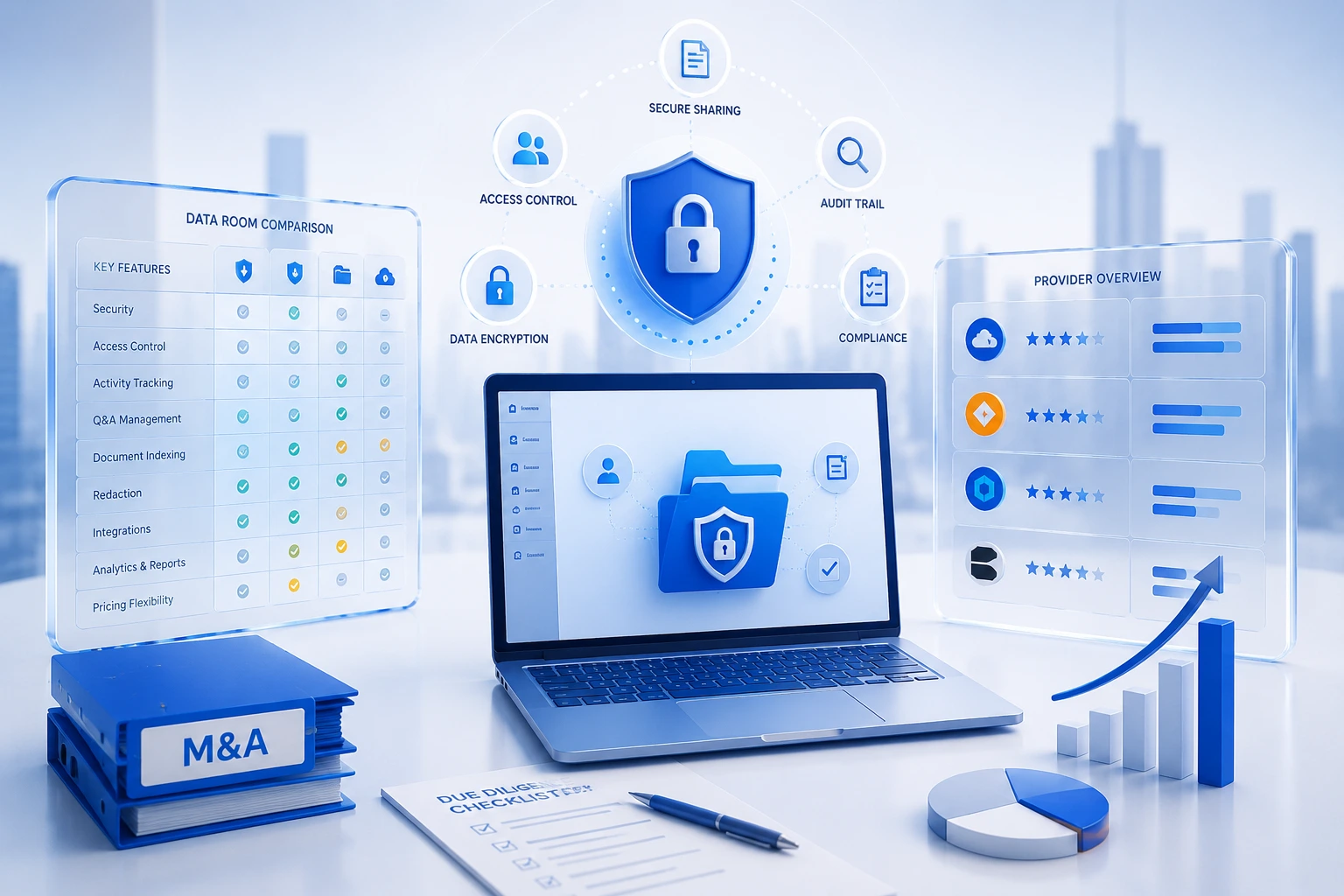
Choosing the best data rooms for M&A means finding a platform that protects confidential documents without slowing down buyers, sellers, advisors, or legal teams. The right virtual data room should also support the workflows that distinguish a live transaction from ordinary file sharing, including bidder separation, granular permissions, structured Q&A, reporting, and a reliable post-close record.
There is no single platform that fits every transaction. A competitive sell-side auction has different requirements from a recurring buy-side acquisition program or a smaller bilateral deal. This guide compares eight established virtual data rooms for mergers and acquisitions based on M&A functionality, pricing approach, security controls, workflow capabilities, and suitability for different deal types.
Last reviewed: September 2026.
For M&A due diligence, shortlist providers according to the transaction rather than the length of their feature lists. Ideals / EthosData is suited to controlled sell-side and buy-side diligence; Datasite and Intralinks are strong candidates for large or complex enterprise deals; DealRoom is differentiated by broader M&A workflow management; Firmex works well for recurring projects; and Ansarada, Drooms, and CapLinked offer different combinations of AI, pricing transparency, and transaction controls.
- Ideals / EthosData: detailed permissions, Q&A, redaction, reporting, and support for controlled M&A due diligence.
- Datasite: large, document-intensive M&A processes and AI-assisted review.
- Intralinks: enterprise transactions and clean-team workflows.
- DealRoom: corporate development teams combining diligence with project management.
- Firmex: advisors and organizations that run recurring mid-market projects.
- Ansarada: AI-assisted preparation, document review, and Q&A.
- Drooms: European and document-heavy transactions with flexible plan structures.
- CapLinked: smaller and mid-sized deals that benefit from published starting prices and post-download controls.
Best data rooms for M&A at a glance
The table below is designed as a shortlisting tool. Pricing and feature availability can change by plan, region, project size, and contract, so buyers should confirm current terms directly with each provider.
| Provider | Best suited to | Key M&A differentiator | Pricing approach |
|---|---|---|---|
| Ideals Visit website EthosData Get a quote | Sell-side and buy-side M&A, advisors, cross-border deals | Granular permissions, structured Q&A, redaction, reporting, and support | Storage and usage-based plans |
| Datasite | Large enterprise and investment-bank-led transactions | M&A-specific workflow with AI-assisted document review | Custom quote |
| Intralinks | Regulated and complex multi-party transactions | Enterprise access controls and clean-team Q&A workflows | Custom quote |
| DealRoom | Corporate development and recurring acquisitions | VDR, diligence requests, tasks, and pipeline workflow in one platform | Deal-volume-based subscription |
| Firmex | Mid-market advisors and repeat projects | Single-project and annual subscription models | Custom project or annual pricing |
| Ansarada | AI-assisted preparation and mid-market deals | AI-supported Q&A, document organization, and review | Published storage-based plans |
| Drooms | European M&A and document-heavy transactions | Flexible data room plans with Q&A, governance, and AI tools | Storage and user-based plans |
| CapLinked | Small and mid-sized transactions | DRM controls, Q&A, unlimited guest users on selected plans | Monthly or enterprise subscription |
How we evaluated M&A data rooms
This comparison focuses on capabilities that matter during a live transaction rather than the total number of features on a provider's website. We used seven criteria to assess how well each platform supports M&A due diligence.
Top virtual data rooms for mergers and acquisitions in 2026
The following profiles focus on what makes each provider different in an M&A context. Each section includes the strongest use case, pricing approach, and an important limitation or point to confirm before signing a contract.
Ideals / EthosData
Ideals is a strong fit for M&A teams that need detailed disclosure controls without making the room difficult for occasional external reviewers to use. EthosData is now part of Ideals, so teams evaluating EthosData should confirm which Ideals platform, plan, contracting entity, and service model will apply to the project.
Ideals supports multiple document permission levels and allows administrators to assign permissions by group across folders and files. Depending on the permission applied, teams can restrict downloading, printing, and access to protected documents. The platform also includes structured Q&A, document redaction, and permissions reporting.
Best for
- Sell-side auctions.
- Buy-side due diligence.
- Investment banks and M&A advisors.
- Private equity and cross-border deals.
Why it stands out
Detailed document permissions, structured Q&A, redaction, reporting, and support make it suitable for transactions where disclosure controls change as the deal progresses.
Pricing
Storage and usage-based plans. Buyers should confirm included storage, overage rates, Q&A availability, AI features, archives, and support.
Point to confirm
Teams that only need basic file sharing may not require the full range of M&A-specific controls.
Product documentation: permissions, redaction, and permissions log.
Datasite
Datasite Diligence is purpose-built around M&A due diligence and is particularly relevant to investment banks, enterprise sellers, and deal teams handling large document sets.
Datasite combines conventional VDR functionality with AI-assisted review tools. Its current product materials describe semantic search, document summaries, clause explanations, Q&A assistance, document comparison, automated redaction, and translation.
Best for
- Large enterprise transactions.
- Investment-bank-led sell-side processes.
- Large document collections.
- Teams using managed transaction services.
Why it stands out
M&A-specific workflows and AI-assisted document review make Datasite particularly relevant when transaction scale and document volume are high.
Pricing
Custom quotation based on transaction scope, requirements, and timeline.
Point to confirm
Smaller transactions should compare the cost and implementation requirements with simpler VDR options.
Product documentation: Datasite Diligence.
Intralinks
Intralinks is an established enterprise VDR used for M&A, private equity, financing, and other sensitive transactions. Its clearest differentiator for complex M&A is support for clean-team workflows.
Intralinks VDRPro supports buyer groups, granular access controls, protected files, printing restrictions, secure downloads, watermarks, and structured Q&A. Clean-team users can submit questions with restricted visibility so competitively sensitive discussions remain limited to authorized participants.
Best for
- Large cross-border M&A.
- Private equity transactions.
- Regulated deals.
- Clean-team processes.
Why it stands out
Clean-team Q&A and enterprise controls are useful where competitively sensitive information cannot be disclosed broadly to a bidder's operating team.
Pricing
Custom quotation. Confirm how data volume, users, support, and extensions affect the contract.
Point to confirm
The depth of configuration may be unnecessary for smaller bilateral transactions with straightforward disclosure needs.
Product documentation: VDRPro setup and clean teams in Q&A.
DealRoom
DealRoom differs from conventional VDRs because it combines document sharing with diligence requests, tasks, pipeline management, and integration planning. This makes it particularly relevant to corporate development teams managing repeated acquisitions.
Instead of keeping a diligence request list in spreadsheets while supporting files sit in a separate repository, DealRoom connects requests, documents, Q&A, and project tasks within the same workflow.
Best for
- Corporate development.
- Recurring buy-side M&A.
- Serial acquirers.
- Diligence request management.
Why it stands out
The platform addresses the coordination problem around diligence, not only the document-sharing problem.
Pricing
Deal-volume-based subscription. DealRoom states that selected plans include unlimited users and data storage.
Point to confirm
A company running one simple sell-side process may not need the wider project-management functionality.
Product documentation: DealRoom pricing and plans.
Firmex
Firmex is a purpose-built VDR used for M&A, legal work, compliance, and other confidential projects. One of its clearer differentiators is the option to choose between a single-project room and an annual subscription for recurring use.
That structure can be useful for investment banks, law firms, consultants, and corporate teams that open several data rooms each year but do not need a broader M&A operating system.
Best for
- Mid-market M&A.
- Advisors and law firms.
- Repeat due diligence projects.
- Recurring confidential workflows.
Why it stands out
Single-project and annual subscription options give recurring users more flexibility than a one-off-only commercial model.
Pricing
Custom project or annual subscription pricing based on project duration and expected data requirements.
Point to confirm
Teams prioritizing extensive AI automation or full M&A pipeline management should compare Firmex with more workflow-heavy platforms.
Product documentation: Firmex pricing.
Ansarada
Ansarada combines a virtual data room with AI-supported preparation, document review, Q&A, and transaction management. Its published pricing also makes early cost comparison easier than with providers that disclose pricing only after a sales consultation.
Current plans are primarily storage-based rather than user-based. The platform includes granular document security, tasks, workflows, and AI functionality, with additional capabilities available on higher plans.
Best for
- Mid-market M&A.
- AI-assisted preparation.
- Large diligence request lists.
- Teams wanting published pricing.
Why it stands out
AI-supported organization, Q&A, document review, and public pricing information create a clearer evaluation path before a sales conversation.
Pricing
Published storage-based plans with term-based discounts. Verify current pricing before purchase.
Point to confirm
Check exactly which AI and Q&A capabilities are included in the selected plan.
Product documentation: Ansarada pricing guide.
Drooms
Drooms is an established VDR option for M&A and other document-intensive transactions, with a particularly visible presence in European markets. The provider offers online subscription plans alongside tailored enterprise configurations.
Higher plan tiers add functionality such as Q&A, advanced reporting, governance controls, readiness tracking, redaction, document translation, and broader AI features.
Best for
- European M&A.
- Document-heavy transactions.
- Real estate-linked deals.
- Repeat data room use.
Why it stands out
Flexible plan structures create an upgrade path from secure document sharing to more advanced transaction workflows.
Pricing
Published subscription tiers based on storage, users, and functionality, plus custom enterprise configurations.
Point to confirm
Features differ materially between tiers, so confirm whether Q&A, AI, advanced permissions, and premium services are included.
Product documentation: Drooms pricing.
CapLinked
CapLinked provides secure data rooms for due diligence and other confidential business processes. Its main differentiators are relatively transparent pricing and digital rights management for downloaded documents.
Its Team plan includes permission-based access, watermarking, activity reporting, OCR search, Q&A, and unlimited guest users. FileProtect can require users to authenticate before opening protected downloaded files and can support revocation or expiration controls.
Best for
- Small and mid-sized transactions.
- One-off due diligence projects.
- Teams comparing published starting prices.
- Deals requiring DRM-protected downloads.
Why it stands out
Published entry pricing and post-download controls provide two concrete differentiators that are easy to evaluate before a demo.
Pricing
Monthly Team and customized Enterprise plans. Check current pricing at the time of purchase because published rates can change.
Point to confirm
Very large investment-bank-led transactions should compare enterprise workflow depth and managed-service requirements with larger M&A platforms.
Product documentation: CapLinked pricing.
Which M&A data room fits your deal?
A provider shortlist becomes easier once the transaction structure is clear. The following scenarios show where each platform's most visible differentiators may matter.
This is a shortlisting guide, not a substitute for testing a platform. Before a live transaction, create a sample project using your own folder structure, permission groups, and expected document volume.
What features matter most in an M&A data room?
The strongest M&A data rooms do more than store confidential files. They help control how information moves between sellers, buyers, advisors, lenders, and specialists throughout due diligence.
Granular permissions and bidder separation
A sell-side process may involve several potential buyers reviewing the same core materials while receiving different access to sensitive documents. The VDR should support separate groups and permission changes without forcing administrators to rebuild the room.
Structured Q&A
A dedicated Q&A module should route questions to internal experts, support review before release, control which bidder can see each response, and preserve the final Q&A history.
Audit trails and activity reporting
Useful reporting can include document access, downloads, permission changes, and Q&A activity. These records create a clearer operational history of disclosure during the deal.
Document protection
Administrators should be able to control whether a file can be viewed, printed, or downloaded. Watermarking, protected viewing, and post-download controls can add further safeguards for sensitive materials.
Search, OCR, and indexing
Automatic indexing, OCR, full-text search, bulk upload, and consistent numbering help reviewers navigate large document sets without repeatedly asking where information is located.
Pricing that matches the transaction
Compare total expected cost rather than the headline rate. Check storage, users, administrators, project duration, extensions, support, archive delivery, and any AI or managed-service charges.
Virtual data room vs. general cloud storage for M&A
General cloud storage can be sufficient during early internal preparation. The requirements change once external buyers and advisors begin reviewing confidential information in a live transaction.
| General cloud storage | M&A virtual data room |
|---|---|
| Designed for everyday file storage and collaboration | Designed for confidential transaction workflows |
| Basic file and folder sharing | Granular bidder and document permissions |
| Activity tracking varies by platform and configuration | Detailed user and document activity reporting |
| Q&A is usually managed in another tool | Structured due diligence Q&A can be built into the platform |
| Basic download controls | Watermarking, secure viewing, protected downloads, or revocation depending on provider |
| Useful for internal preparation and routine collaboration | Better suited to external buyer review and staged disclosure |
How virtual data rooms support mergers and acquisitions
A data room supports several stages of the transaction rather than only the initial document upload. This is why dedicated VDRs should be evaluated as transaction infrastructure rather than simply secure storage.
Common documents stored in an M&A data room
The exact index depends on the company, industry, transaction structure, and diligence scope. Sensitive customer information, employee data, pricing information, source code, or competitively sensitive commercial materials may require staged disclosure, redaction, or clean-team access.
| Category | Common documents | Main diligence purpose |
|---|---|---|
| Corporate | Articles, bylaws, board minutes, shareholder agreements, cap table | Confirm ownership, governance, and authority |
| Financial | Financial statements, management accounts, forecasts, debt schedules | Evaluate performance, cash flow, and financial risk |
| Tax | Tax returns, correspondence, indirect tax records, transfer pricing files | Identify tax exposures and compliance issues |
| Legal | Material contracts, litigation, licenses, leases | Review obligations, disputes, and change-of-control provisions |
| HR | Employee lists, compensation, benefits, employment agreements | Assess workforce obligations and retention issues |
| IP and technology | Patents, trademarks, licenses, software documentation, cybersecurity materials | Confirm ownership and identify technology or security risks |
| Commercial | Customer data, pipeline, churn, supplier information | Assess revenue quality and concentration |
| Operations | Insurance, facilities, procedures, supplier records | Review operational continuity and scalability |
How to choose the best M&A data room
Start with the transaction rather than the provider's feature list. For a competitive auction, bidder separation and controlled Q&A may be critical. For a corporate development team completing several acquisitions each year, workflow and repeat-project economics may matter more.
- Estimate document volume and expected transaction duration.
- Identify how many bidder, advisor, and internal groups need separate permissions.
- Test the Q&A workflow using a realistic diligence scenario.
- Upload several large folders to evaluate indexing, search, and permissions.
- Review security and compliance documentation rather than relying on broad claims.
- Ask how access and permission changes are recorded and exported.
- Confirm storage overages, project extensions, archives, support, and additional modules.
- Check how quickly access can be revoked if a bidder leaves the process.
- Understand how AI tools process deal documents and whether outputs link back to source material.
- Confirm what happens to the data room after signing or closing.
Final comparison
There is no universal M&A data room for every transaction. Ideals / EthosData is well suited to teams that need detailed permissions, Q&A, reporting, and document controls across controlled due diligence. Datasite is particularly relevant to large, document-intensive transactions, while Intralinks is differentiated by clean-team functionality for sensitive enterprise deals.
DealRoom stands apart through broader corporate-development workflow management. Firmex is practical for recurring projects, while Ansarada and Drooms combine VDR functionality with expanding AI capabilities. CapLinked is worth comparing where published starting prices and DRM-protected downloads are priorities.
The most reliable way to choose among the best data rooms for M&A is to shortlist providers according to the transaction and then test the workflows that actually matter: permissions, Q&A, search, reporting, bidder separation, and closing archives.
Compare your expected storage, users, bidder groups, Q&A requirements, support needs, and transaction timeline before requesting a final quote.
Request a proposalFAQs about M&A data rooms
What is an M&A data room?
An M&A data room is a secure online workspace used to organize, share, and review confidential documents during a merger, acquisition, divestiture, or similar transaction. Sellers use it to control disclosure, while buyers and advisors use it to conduct due diligence.
What are the best data rooms for M&A in 2026?
Commonly shortlisted M&A data room providers include Ideals / EthosData, Datasite, Intralinks, DealRoom, Firmex, Ansarada, Drooms, and CapLinked. The appropriate provider depends on deal size, bidder count, document volume, Q&A requirements, security controls, pricing model, and support.
What are virtual data rooms for mergers and acquisitions used for?
Virtual data rooms for mergers and acquisitions are used to prepare documents, manage buyer access, conduct due diligence, organize Q&A, monitor document activity, and maintain transaction records. They replace scattered email attachments and basic file-sharing links with a controlled deal workspace.
Why are virtual data rooms important in M&A?
M&A transactions require companies to disclose large volumes of confidential information to outside parties. A VDR helps administrators control who can access each document, track activity, manage buyer questions, and change permissions as the transaction progresses.
What should an M&A virtual data room include?
Important capabilities include granular permissions, bidder groups, document watermarking, view and download controls, structured Q&A, audit logs, full-text search, OCR, bulk upload, activity reporting, and secure post-close archiving. The exact requirements depend on the deal.
What is the difference between an M&A data room and Dropbox, Box, or SharePoint?
General cloud platforms are designed primarily for everyday file storage and collaboration. A purpose-built M&A data room usually adds transaction-specific controls such as bidder separation, detailed audit trails, document-level restrictions, structured Q&A, staged disclosure, and deal-specific reporting.
How much does an M&A data room cost?
Pricing varies by provider. Common models include storage-based pricing, fixed project fees, monthly subscriptions, annual subscriptions, user-based charges, and custom enterprise quotes. Teams should compare the total expected cost, including overages, extensions, support, AI modules, and archive delivery.
How long should an M&A data room stay open?
The room normally remains active throughout due diligence, negotiation, signing, and any period required for closing activities. After the transaction, teams may close external access and retain an archive of relevant documents, Q&A, and activity records according to legal and record-retention requirements.
Can several bidders use the same M&A data room?
Yes. Purpose-built VDRs can place bidders in separate groups and apply different permissions to each group. Sellers should test bidder isolation, Q&A visibility, and document-level permissions before opening a competitive process.