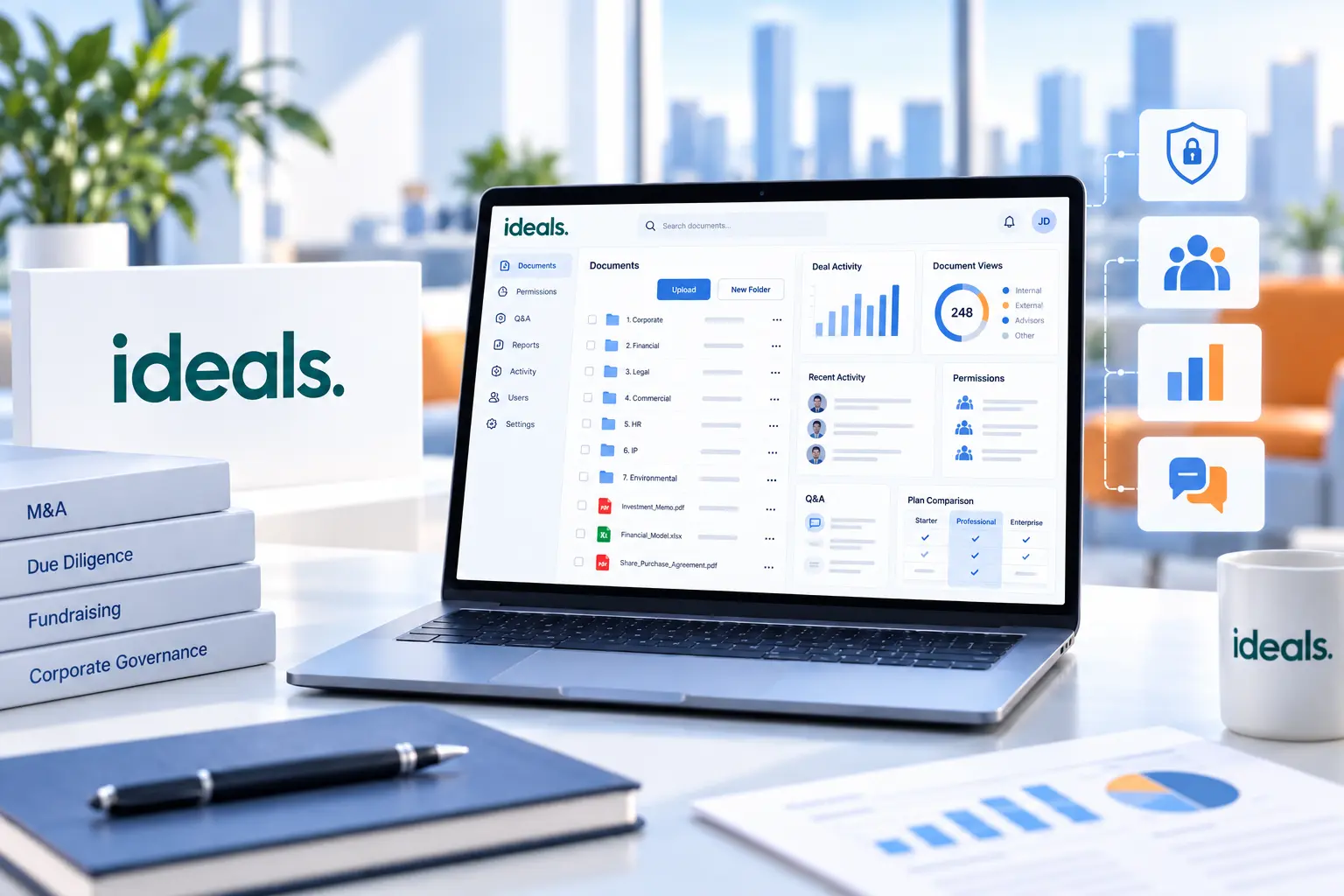
Best Virtual Data Rooms for M&A in 2026: 8 Providers Compared

Choosing the best data rooms for M&A means finding a platform that protects confidential documents without slowing down buyers, sellers, advisors, or legal teams. The right virtual data room should also support the workflows that distinguish a live transaction from ordinary file sharing, including bidder separation, granular permissions, structured Q&A, reporting, and a reliable post-close record.

There is no single platform that fits every transaction. A competitive sell-side auction has different requirements from a recurring buy-side acquisition program or a smaller bilateral deal. This guide compares eight established virtual data rooms for mergers and acquisitions based on M&A functionality, pricing approach, security controls, workflow capabilities, and suitability for different deal types.

Last reviewed: September 2026.

Quick answer

For M&A due diligence, shortlist providers according to the transaction rather than the length of their feature lists. Ideals / EthosData is suited to controlled sell-side and buy-side diligence; Datasite and Intralinks are strong candidates for large or complex enterprise deals; DealRoom is differentiated by broader M&A workflow management; Firmex works well for recurring projects; and Ansarada, Drooms, and CapLinked offer different combinations of AI, pricing transparency, and transaction controls.

Key takeaways
  • Ideals / EthosData: detailed permissions, Q&A, redaction, reporting, and support for controlled M&A due diligence.
  • Datasite: large, document-intensive M&A processes and AI-assisted review.
  • Intralinks: enterprise transactions and clean-team workflows.
  • DealRoom: corporate development teams combining diligence with project management.
  • Firmex: advisors and organizations that run recurring mid-market projects.
  • Ansarada: AI-assisted preparation, document review, and Q&A.
  • Drooms: European and document-heavy transactions with flexible plan structures.
  • CapLinked: smaller and mid-sized deals that benefit from published starting prices and post-download controls.

Best data rooms for M&A at a glance

The table below is designed as a shortlisting tool. Pricing and feature availability can change by plan, region, project size, and contract, so buyers should confirm current terms directly with each provider.

Scroll horizontally to view the full table.
ProviderBest suited toKey M&A differentiatorPricing approach
Ideals Visit website EthosData Get a quoteSell-side and buy-side M&A, advisors, cross-border dealsGranular permissions, structured Q&A, redaction, reporting, and supportStorage and usage-based plans
DatasiteLarge enterprise and investment-bank-led transactionsM&A-specific workflow with AI-assisted document reviewCustom quote
IntralinksRegulated and complex multi-party transactionsEnterprise access controls and clean-team Q&A workflowsCustom quote
DealRoomCorporate development and recurring acquisitionsVDR, diligence requests, tasks, and pipeline workflow in one platformDeal-volume-based subscription
FirmexMid-market advisors and repeat projectsSingle-project and annual subscription modelsCustom project or annual pricing
AnsaradaAI-assisted preparation and mid-market dealsAI-supported Q&A, document organization, and reviewPublished storage-based plans
DroomsEuropean M&A and document-heavy transactionsFlexible data room plans with Q&A, governance, and AI toolsStorage and user-based plans
CapLinkedSmall and mid-sized transactionsDRM controls, Q&A, unlimited guest users on selected plansMonthly or enterprise subscription

How we evaluated M&A data rooms

This comparison focuses on capabilities that matter during a live transaction rather than the total number of features on a provider's website. We used seven criteria to assess how well each platform supports M&A due diligence.

1. Access control Buyer groups and permissions at group, folder, document, or transaction-stage level.
2. Document security Watermarking, secure viewing, protected downloads, redaction, and access revocation where supported.
3. Due diligence Q&A Question routing, internal review, approvals, buyer-group separation, and Q&A history.
4. Document management Bulk upload, indexing, OCR, search, version control, and handling of large document sets.
5. Reporting Visibility into user activity, document views, downloads, permissions, and audit records.
6. M&A workflow Support for preparation, bidder management, diligence, negotiation, and closing rather than storage alone.
7. Commercial model How the provider charges for storage, projects, users, duration, support, or additional services.
Disclosure: EthosData is part of Ideals. This comparison therefore treats EthosData and Ideals as one provider relationship rather than presenting them as independent competing platforms.

Top virtual data rooms for mergers and acquisitions in 2026

The following profiles focus on what makes each provider different in an M&A context. Each section includes the strongest use case, pricing approach, and an important limitation or point to confirm before signing a contract.

For controlled sell-side and buy-side diligence

Ideals / EthosData

Ideals is a strong fit for M&A teams that need detailed disclosure controls without making the room difficult for occasional external reviewers to use. EthosData is now part of Ideals, so teams evaluating EthosData should confirm which Ideals platform, plan, contracting entity, and service model will apply to the project.

Ideals supports multiple document permission levels and allows administrators to assign permissions by group across folders and files. Depending on the permission applied, teams can restrict downloading, printing, and access to protected documents. The platform also includes structured Q&A, document redaction, and permissions reporting.

Best for

  • Sell-side auctions.
  • Buy-side due diligence.
  • Investment banks and M&A advisors.
  • Private equity and cross-border deals.

Why it stands out

Detailed document permissions, structured Q&A, redaction, reporting, and support make it suitable for transactions where disclosure controls change as the deal progresses.

Pricing

Storage and usage-based plans. Buyers should confirm included storage, overage rates, Q&A availability, AI features, archives, and support.

Point to confirm

Teams that only need basic file sharing may not require the full range of M&A-specific controls.

Distinctive M&A use case: Controlled disclosure across several buyer or advisor groups, especially when permissions, Q&A, and audit records need to be managed centrally.

Product documentation: permissions, redaction, and permissions log.

For large and document-intensive M&A

Datasite

Datasite Diligence is purpose-built around M&A due diligence and is particularly relevant to investment banks, enterprise sellers, and deal teams handling large document sets.

Datasite combines conventional VDR functionality with AI-assisted review tools. Its current product materials describe semantic search, document summaries, clause explanations, Q&A assistance, document comparison, automated redaction, and translation.

Best for

  • Large enterprise transactions.
  • Investment-bank-led sell-side processes.
  • Large document collections.
  • Teams using managed transaction services.

Why it stands out

M&A-specific workflows and AI-assisted document review make Datasite particularly relevant when transaction scale and document volume are high.

Pricing

Custom quotation based on transaction scope, requirements, and timeline.

Point to confirm

Smaller transactions should compare the cost and implementation requirements with simpler VDR options.

Distinctive M&A use case: Large, document-heavy transactions where the deal team values an enterprise M&A platform and AI-assisted review.

Product documentation: Datasite Diligence.

For clean teams and regulated transactions

Intralinks

Intralinks is an established enterprise VDR used for M&A, private equity, financing, and other sensitive transactions. Its clearest differentiator for complex M&A is support for clean-team workflows.

Intralinks VDRPro supports buyer groups, granular access controls, protected files, printing restrictions, secure downloads, watermarks, and structured Q&A. Clean-team users can submit questions with restricted visibility so competitively sensitive discussions remain limited to authorized participants.

Best for

  • Large cross-border M&A.
  • Private equity transactions.
  • Regulated deals.
  • Clean-team processes.

Why it stands out

Clean-team Q&A and enterprise controls are useful where competitively sensitive information cannot be disclosed broadly to a bidder's operating team.

Pricing

Custom quotation. Confirm how data volume, users, support, and extensions affect the contract.

Point to confirm

The depth of configuration may be unnecessary for smaller bilateral transactions with straightforward disclosure needs.

Distinctive M&A use case: Transactions requiring clean-team separation and enterprise-grade controls around sensitive information.

Product documentation: VDRPro setup and clean teams in Q&A.

For corporate development and recurring acquisitions

DealRoom

DealRoom differs from conventional VDRs because it combines document sharing with diligence requests, tasks, pipeline management, and integration planning. This makes it particularly relevant to corporate development teams managing repeated acquisitions.

Instead of keeping a diligence request list in spreadsheets while supporting files sit in a separate repository, DealRoom connects requests, documents, Q&A, and project tasks within the same workflow.

Best for

  • Corporate development.
  • Recurring buy-side M&A.
  • Serial acquirers.
  • Diligence request management.

Why it stands out

The platform addresses the coordination problem around diligence, not only the document-sharing problem.

Pricing

Deal-volume-based subscription. DealRoom states that selected plans include unlimited users and data storage.

Point to confirm

A company running one simple sell-side process may not need the wider project-management functionality.

Distinctive M&A use case: Buy-side teams that want requests, documents, ownership, tasks, and progress tracking in one environment.

Product documentation: DealRoom pricing and plans.

For repeat mid-market transactions

Firmex

Firmex is a purpose-built VDR used for M&A, legal work, compliance, and other confidential projects. One of its clearer differentiators is the option to choose between a single-project room and an annual subscription for recurring use.

That structure can be useful for investment banks, law firms, consultants, and corporate teams that open several data rooms each year but do not need a broader M&A operating system.

Best for

  • Mid-market M&A.
  • Advisors and law firms.
  • Repeat due diligence projects.
  • Recurring confidential workflows.

Why it stands out

Single-project and annual subscription options give recurring users more flexibility than a one-off-only commercial model.

Pricing

Custom project or annual subscription pricing based on project duration and expected data requirements.

Point to confirm

Teams prioritizing extensive AI automation or full M&A pipeline management should compare Firmex with more workflow-heavy platforms.

Distinctive M&A use case: Advisors and mid-market teams that need reliable VDR controls across one project or many recurring projects.

Product documentation: Firmex pricing.

For AI-assisted deal preparation

Ansarada

Ansarada combines a virtual data room with AI-supported preparation, document review, Q&A, and transaction management. Its published pricing also makes early cost comparison easier than with providers that disclose pricing only after a sales consultation.

Current plans are primarily storage-based rather than user-based. The platform includes granular document security, tasks, workflows, and AI functionality, with additional capabilities available on higher plans.

Best for

  • Mid-market M&A.
  • AI-assisted preparation.
  • Large diligence request lists.
  • Teams wanting published pricing.

Why it stands out

AI-supported organization, Q&A, document review, and public pricing information create a clearer evaluation path before a sales conversation.

Pricing

Published storage-based plans with term-based discounts. Verify current pricing before purchase.

Point to confirm

Check exactly which AI and Q&A capabilities are included in the selected plan.

Distinctive M&A use case: Deal teams that want AI-assisted preparation and a more transparent starting point for pricing comparison.

Product documentation: Ansarada pricing guide.

For European and structured transaction workflows

Drooms

Drooms is an established VDR option for M&A and other document-intensive transactions, with a particularly visible presence in European markets. The provider offers online subscription plans alongside tailored enterprise configurations.

Higher plan tiers add functionality such as Q&A, advanced reporting, governance controls, readiness tracking, redaction, document translation, and broader AI features.

Best for

  • European M&A.
  • Document-heavy transactions.
  • Real estate-linked deals.
  • Repeat data room use.

Why it stands out

Flexible plan structures create an upgrade path from secure document sharing to more advanced transaction workflows.

Pricing

Published subscription tiers based on storage, users, and functionality, plus custom enterprise configurations.

Point to confirm

Features differ materially between tiers, so confirm whether Q&A, AI, advanced permissions, and premium services are included.

Distinctive M&A use case: European deal teams that want a tiered product structure and may expand from basic secure sharing into more advanced transaction functionality.

Product documentation: Drooms pricing.

For predictable pricing and post-download control

CapLinked

CapLinked provides secure data rooms for due diligence and other confidential business processes. Its main differentiators are relatively transparent pricing and digital rights management for downloaded documents.

Its Team plan includes permission-based access, watermarking, activity reporting, OCR search, Q&A, and unlimited guest users. FileProtect can require users to authenticate before opening protected downloaded files and can support revocation or expiration controls.

Best for

  • Small and mid-sized transactions.
  • One-off due diligence projects.
  • Teams comparing published starting prices.
  • Deals requiring DRM-protected downloads.

Why it stands out

Published entry pricing and post-download controls provide two concrete differentiators that are easy to evaluate before a demo.

Pricing

Monthly Team and customized Enterprise plans. Check current pricing at the time of purchase because published rates can change.

Point to confirm

Very large investment-bank-led transactions should compare enterprise workflow depth and managed-service requirements with larger M&A platforms.

Distinctive M&A use case: Smaller and mid-market deals where predictable cost and control over downloaded files are priorities.

Product documentation: CapLinked pricing.

Which M&A data room fits your deal?

A provider shortlist becomes easier once the transaction structure is clear. The following scenarios show where each platform's most visible differentiators may matter.

Competitive sell-side auction Consider Ideals, Datasite, or Intralinks when bidder separation, permissions, Q&A, and reporting are central.
Large enterprise transaction Datasite, Intralinks, and Ideals are relevant where scale, document controls, support, and complex workflows matter.
Clean-team process Intralinks is particularly relevant because it documents dedicated clean-team Q&A functionality.
Recurring corporate acquisitions DealRoom and Firmex address repeat-deal needs through workflow management or recurring subscription models.
AI-heavy document preparation Datasite, Ansarada, Drooms, and Ideals all offer AI-assisted functionality, although the specific tools and plan availability differ.
Published pricing as an early filter Ansarada, Drooms, and CapLinked provide more public pricing information than providers that rely entirely on custom quotations.

This is a shortlisting guide, not a substitute for testing a platform. Before a live transaction, create a sample project using your own folder structure, permission groups, and expected document volume.

What features matter most in an M&A data room?

The strongest M&A data rooms do more than store confidential files. They help control how information moves between sellers, buyers, advisors, lenders, and specialists throughout due diligence.

Granular permissions and bidder separation

A sell-side process may involve several potential buyers reviewing the same core materials while receiving different access to sensitive documents. The VDR should support separate groups and permission changes without forcing administrators to rebuild the room.

Structured Q&A

A dedicated Q&A module should route questions to internal experts, support review before release, control which bidder can see each response, and preserve the final Q&A history.

Audit trails and activity reporting

Useful reporting can include document access, downloads, permission changes, and Q&A activity. These records create a clearer operational history of disclosure during the deal.

Document protection

Administrators should be able to control whether a file can be viewed, printed, or downloaded. Watermarking, protected viewing, and post-download controls can add further safeguards for sensitive materials.

Search, OCR, and indexing

Automatic indexing, OCR, full-text search, bulk upload, and consistent numbering help reviewers navigate large document sets without repeatedly asking where information is located.

Pricing that matches the transaction

Compare total expected cost rather than the headline rate. Check storage, users, administrators, project duration, extensions, support, archive delivery, and any AI or managed-service charges.

Virtual data room vs. general cloud storage for M&A

General cloud storage can be sufficient during early internal preparation. The requirements change once external buyers and advisors begin reviewing confidential information in a live transaction.

Scroll horizontally to view the full table.
General cloud storageM&A virtual data room
Designed for everyday file storage and collaborationDesigned for confidential transaction workflows
Basic file and folder sharingGranular bidder and document permissions
Activity tracking varies by platform and configurationDetailed user and document activity reporting
Q&A is usually managed in another toolStructured due diligence Q&A can be built into the platform
Basic download controlsWatermarking, secure viewing, protected downloads, or revocation depending on provider
Useful for internal preparation and routine collaborationBetter suited to external buyer review and staged disclosure

How virtual data rooms support mergers and acquisitions

A data room supports several stages of the transaction rather than only the initial document upload. This is why dedicated VDRs should be evaluated as transaction infrastructure rather than simply secure storage.

Preparation. Sellers collect financial, legal, tax, HR, commercial, and technical documents, remove duplicates, build an index, and identify materials that require restricted access.
Buyer onboarding. Bidders and advisors are assigned to groups with permissions appropriate to their role and stage of the process.
Due diligence. Reviewers examine the business and submit requests or questions about missing, unclear, or higher-risk information.
Q&A. Questions are routed to internal subject-matter experts and approved before answers are released to the relevant bidder.
Negotiation and signing. Updated documents, disclosure materials, transaction agreements, and supporting schedules can be released as negotiations progress.
Closing and archive. The final room, Q&A history, activity reports, and relevant transaction documents can be retained or exported according to the provider's archive process.

Common documents stored in an M&A data room

The exact index depends on the company, industry, transaction structure, and diligence scope. Sensitive customer information, employee data, pricing information, source code, or competitively sensitive commercial materials may require staged disclosure, redaction, or clean-team access.

Scroll horizontally to view the full table.
CategoryCommon documentsMain diligence purpose
CorporateArticles, bylaws, board minutes, shareholder agreements, cap tableConfirm ownership, governance, and authority
FinancialFinancial statements, management accounts, forecasts, debt schedulesEvaluate performance, cash flow, and financial risk
TaxTax returns, correspondence, indirect tax records, transfer pricing filesIdentify tax exposures and compliance issues
LegalMaterial contracts, litigation, licenses, leasesReview obligations, disputes, and change-of-control provisions
HREmployee lists, compensation, benefits, employment agreementsAssess workforce obligations and retention issues
IP and technologyPatents, trademarks, licenses, software documentation, cybersecurity materialsConfirm ownership and identify technology or security risks
CommercialCustomer data, pipeline, churn, supplier informationAssess revenue quality and concentration
OperationsInsurance, facilities, procedures, supplier recordsReview operational continuity and scalability

How to choose the best M&A data room

Start with the transaction rather than the provider's feature list. For a competitive auction, bidder separation and controlled Q&A may be critical. For a corporate development team completing several acquisitions each year, workflow and repeat-project economics may matter more.

  • Estimate document volume and expected transaction duration.
  • Identify how many bidder, advisor, and internal groups need separate permissions.
  • Test the Q&A workflow using a realistic diligence scenario.
  • Upload several large folders to evaluate indexing, search, and permissions.
  • Review security and compliance documentation rather than relying on broad claims.
  • Ask how access and permission changes are recorded and exported.
  • Confirm storage overages, project extensions, archives, support, and additional modules.
  • Check how quickly access can be revoked if a bidder leaves the process.
  • Understand how AI tools process deal documents and whether outputs link back to source material.
  • Confirm what happens to the data room after signing or closing.

Final comparison

There is no universal M&A data room for every transaction. Ideals / EthosData is well suited to teams that need detailed permissions, Q&A, reporting, and document controls across controlled due diligence. Datasite is particularly relevant to large, document-intensive transactions, while Intralinks is differentiated by clean-team functionality for sensitive enterprise deals.

DealRoom stands apart through broader corporate-development workflow management. Firmex is practical for recurring projects, while Ansarada and Drooms combine VDR functionality with expanding AI capabilities. CapLinked is worth comparing where published starting prices and DRM-protected downloads are priorities.

The most reliable way to choose among the best data rooms for M&A is to shortlist providers according to the transaction and then test the workflows that actually matter: permissions, Q&A, search, reporting, bidder separation, and closing archives.

Evaluating an M&A data room?

Compare your expected storage, users, bidder groups, Q&A requirements, support needs, and transaction timeline before requesting a final quote.

Request a proposal

FAQs about M&A data rooms

What is an M&A data room?

An M&A data room is a secure online workspace used to organize, share, and review confidential documents during a merger, acquisition, divestiture, or similar transaction. Sellers use it to control disclosure, while buyers and advisors use it to conduct due diligence.

What are the best data rooms for M&A in 2026?

Commonly shortlisted M&A data room providers include Ideals / EthosData, Datasite, Intralinks, DealRoom, Firmex, Ansarada, Drooms, and CapLinked. The appropriate provider depends on deal size, bidder count, document volume, Q&A requirements, security controls, pricing model, and support.

What are virtual data rooms for mergers and acquisitions used for?

Virtual data rooms for mergers and acquisitions are used to prepare documents, manage buyer access, conduct due diligence, organize Q&A, monitor document activity, and maintain transaction records. They replace scattered email attachments and basic file-sharing links with a controlled deal workspace.

Why are virtual data rooms important in M&A?

M&A transactions require companies to disclose large volumes of confidential information to outside parties. A VDR helps administrators control who can access each document, track activity, manage buyer questions, and change permissions as the transaction progresses.

What should an M&A virtual data room include?

Important capabilities include granular permissions, bidder groups, document watermarking, view and download controls, structured Q&A, audit logs, full-text search, OCR, bulk upload, activity reporting, and secure post-close archiving. The exact requirements depend on the deal.

What is the difference between an M&A data room and Dropbox, Box, or SharePoint?

General cloud platforms are designed primarily for everyday file storage and collaboration. A purpose-built M&A data room usually adds transaction-specific controls such as bidder separation, detailed audit trails, document-level restrictions, structured Q&A, staged disclosure, and deal-specific reporting.

How much does an M&A data room cost?

Pricing varies by provider. Common models include storage-based pricing, fixed project fees, monthly subscriptions, annual subscriptions, user-based charges, and custom enterprise quotes. Teams should compare the total expected cost, including overages, extensions, support, AI modules, and archive delivery.

How long should an M&A data room stay open?

The room normally remains active throughout due diligence, negotiation, signing, and any period required for closing activities. After the transaction, teams may close external access and retain an archive of relevant documents, Q&A, and activity records according to legal and record-retention requirements.

Can several bidders use the same M&A data room?

Yes. Purpose-built VDRs can place bidders in separate groups and apply different permissions to each group. Sellers should test bidder isolation, Q&A visibility, and document-level permissions before opening a competitive process.


Virtual data room for M&A deals

Choosing the best virtual data room for M&A means finding a platform that can protect confidential documents without slowing down buyers, sellers, advisors or legal teams.

The right platform should make it easy to organise the room, separate bidder groups, manage permissions, coordinate Q&A and preserve an auditable record of the transaction. The best choice will also depend on whether you are managing one sell-side process, a recurring buy-side pipeline or a large cross-border transaction.

Quick answer: For serious M&A due diligence, the best data room is usually a dedicated virtual data room with role-based permissions, document-level controls, watermarking, Q&A, real-time activity tracking and audit trails. Ideals is the best overall provider in this guide, while EthosData remains an important M&A data room option to evaluate because it is now part of Ideals and is still searched by buyers under the EthosData name.

Best data rooms for M&A: provider comparison

The best virtual data rooms for M&A 2026 depend on deal size, buyer count, document sensitivity, budget and the amount of support your team needs. Use this comparison as a shortlisting tool before scheduling demos or requesting quotes.

Scroll horizontally to view the full table.
ProviderOur categoryParticularly suitable forPricing approach
Ideals
Visit website
MainSell-side and buy-side M&A, advisors and complex due diligenceUsage and storage-based plans
EthosData
Get a quote
MainSell-side and buy-side M&A, advisors and complex due diligenceUsage and storage-based plans
DatasiteBest for large enterprise transactionsLarge M&A processes, investment banks and document-heavy diligenceCustom quote
IntralinksBest for regulated and clean-team workflowsEnterprise M&A, private equity and sensitive multi-party reviewCustom quote
DealRoomBest for M&A workflow managementCorporate development and teams combining diligence with project managementFlat-rate plans based on deal volume
FirmexBest for repeat mid-market projectsAdvisors, legal teams and organisations running recurring data roomsSingle-project or annual subscription
AnsaradaBest for AI-led preparationDeal teams prioritising AI-assisted organisation, search and Q&AOnline or quote-based plans
DroomsBest for European and real-estate-led dealsEuropean M&A, real estate and structured document-heavy projectsTiered user and feature-based plans
SecureDocsBest for straightforward smaller projectsStartups, smaller transactions and teams seeking simple flat pricingFlat fee from $250 per month
Pricing and features can change. Request a written quotation that specifies storage, administrators, external users, support, archives, AI tools, overage charges and extensions before making a final decision.

Our recommendations

Best overall virtual data room for M&A

Ideals

Ideals offers a strong balance of security, usability, M&A workflow functionality, reporting and support.

Best for large enterprise M&A

Datasite

Datasite is designed specifically around large-scale M&A diligence and increasingly extensive AI-assisted document review.

Best for regulated transactions

Intralinks

Intralinks is a long-established enterprise VDR with granular controls, structured Q&A and clean-team functionality.

Best for corporate development

DealRoom

DealRoom connects diligence requests, tasks and documents in one M&A workflow rather than functioning only as a document repository.

Best for recurring mid-market projects

Firmex

Firmex offers both single-project and annual subscription options, making it relevant to advisors and teams running several confidential projects.

Best for AI-led deal preparation

Ansarada

Ansarada combines its data room with AI-assisted sorting, redaction, document search and Q&A capabilities.

Best for European transactions

Drooms

Drooms provides structured data-room functionality alongside redaction, Q&A and AI-assisted document organisation.

Best for simple flat-fee requirements

SecureDocs

SecureDocs offers a comparatively straightforward product and advertises flat monthly pricing with unlimited users and document storage.

When general tools are enough — and when an M&A data room is better

Not every confidential file exchange needs a full virtual data room. For early internal preparation, a secure cloud folder may be enough to collect draft materials, align advisors or prepare an initial diligence checklist. General tools can be useful when there are no external bidders, no live due diligence process and no need for detailed disclosure records.

Once a deal becomes live, the risk profile changes. M&A online data rooms are designed for situations where sensitive documents must be shared with multiple outside parties while the seller still controls access. That is where a dedicated M&A data room is usually more suitable than a normal shared drive.

Scroll horizontally to view the full table.
Generic cloud storage
M&A virtual data room
Built for everyday file storage and collaboration
Built for M&A, due diligence and regulated document review
Useful for early internal preparation and low-risk file sharing
Better for live buyer access, staged disclosure and external review
Usually offers basic folder or file sharing permissions
Supports granular user, group, folder and document permissions
Activity tracking may be limited or configuration-dependent
Designed for M&A data rooms with real-time access logs and audit trails
Q&A workflows are usually not included by default
Includes structured Q&A workflows for due diligence teams
Watermarking, secure viewing and download controls may be limited
Can include dynamic watermarks, secure viewer controls and access revocation
Better fit for casual sharing and internal collaboration
Better fit for high-stakes M&A, fundraising, IPO and legal review

Top data rooms for M&A deals in 2026

The following six provider profiles focus on the strongest shortlist options for live M&A due diligence. Each profile covers the provider’s most relevant capabilities, ideal use cases, pricing approach and the points buyers should confirm before signing a contract.

Best for large enterprise M&A

Datasite

Datasite Diligence is built specifically for M&A due diligence and is particularly relevant to large investment banks, enterprise sellers and document-heavy transactions.

The platform provides bulk uploads, redaction, search, integrated Q&A and permission-aware AI features. Datasite describes its Blueflame AI as operating within the project’s content and existing user permissions. It can support document navigation, semantic search and Q&A drafting.

Datasite also offers preparation and post-closing products, making it relevant to teams looking for technology across more of the deal lifecycle.

Best for

  • Large enterprise M&A.
  • Investment banks.
  • Global sell-side processes.
  • Large document collections.
  • Teams prioritising AI-assisted review and redaction.
  • Transactions requiring extensive managed services.

Key strengths

  • Purpose-built M&A infrastructure.
  • Granular role-based permissions.
  • Bulk upload and redaction.
  • Semantic and AI-assisted search.
  • Integrated Q&A.
  • Detailed audit trail.
  • Broader lifecycle products.

Pricing

Pricing is generally provided through a custom quotation. Prospective customers should ask how storage, services, archive requirements and project extensions affect the total cost.

Points to confirm

  • Total cost for the expected document volume.
  • Which AI capabilities are included.
  • Managed-services charges.
  • Archive costs.
  • Ease of use for occasional external reviewers.
Our verdict: A strong option for large, sophisticated transactions, although smaller teams should determine whether they need the full platform and service model.
Best for regulated and clean-team workflows

Intralinks

Intralinks is an established virtual data room provider used for enterprise M&A, private equity, financing and other sensitive transactions.

Its published VDR functionality includes granular permissions, document protection, watermarking, secure viewing, audit reporting, bulk upload and Q&A.

Intralinks is particularly relevant where the transaction requires clean teams. Its VDRPro Q&A workflow can separate sensitive clean-team communication and allows Q&A coordinators to delegate questions to subject-matter experts.

Best for

  • Regulated enterprise transactions.
  • Large cross-border M&A.
  • Private equity.
  • Clean-team processes.
  • Investment banks.
  • Teams already familiar with Intralinks.

Key strengths

  • Long-established enterprise platform.
  • Granular permissions.
  • Document protection.
  • Q&A coordinators and subject-matter experts.
  • Clean-team Q&A.
  • Audit trails and reporting.
  • Deal-services availability.

Pricing

Intralinks generally requires a custom quote. The provider states that price can depend on data volume, users, features and support requirements.

Points to confirm

  • Setup and implementation requirements.
  • Clean-team configuration.
  • Support included in the contract.
  • Overage and extension rates.
  • External-user experience.
  • Archive delivery.
Our verdict: Well suited to complex, regulated transactions in which clean-team functionality and enterprise controls are essential.
Best for M&A workflow management

DealRoom

DealRoom combines virtual data room functionality with M&A project and diligence management.

Instead of keeping the diligence request list in one system and supporting documents in another, teams can connect requests, documents and workflow tasks in the same platform. DealRoom also documents version control, redaction, audit trails, OCR and AI-assisted document analysis.

This makes it particularly relevant to corporate development teams that want to manage an acquisition pipeline and the diligence process rather than only disclose files.

Best for

  • Corporate development.
  • Recurring buy-side M&A.
  • Diligence request management.
  • Teams replacing spreadsheet trackers.
  • Transactions requiring extensive task coordination.
  • Organisations managing several active deals.

Key strengths

  • Documents linked to diligence requests.
  • Task and workflow management.
  • Version control.
  • Audit trails.
  • OCR and document search.
  • AI-assisted document analysis.
  • Centralised deal information.

Pricing

DealRoom says its pricing is based on the number of deals, with flat-rate plans that include unlimited users and data storage.

Points to confirm

  • Which modules are included.
  • Whether the organisation needs full workflow management.
  • Onboarding requirements.
  • Integration capabilities.
  • Archive and post-closing options.
Our verdict: A compelling choice for buy-side and corporate-development teams whose main problem is coordinating the wider diligence process, not merely storing documents.
Best for repeat mid-market projects

Firmex

Firmex provides purpose-built virtual data rooms for M&A, legal, compliance and other confidential projects.

Its buy-side offering includes due diligence checklists and a dedicated email address through which target companies can add files to the data room.

Firmex is relevant to legal firms, advisors and other organisations that require either a single transaction room or a continuing subscription for multiple projects.

Best for

  • Mid-market M&A.
  • Law firms and advisors.
  • Repeat diligence projects.
  • Buy-side teams.
  • Compliance and audit work.
  • Organisations that want an annual data-room subscription.

Key strengths

  • Purpose-built VDR.
  • Due diligence checklists.
  • Advanced document controls.
  • Single-project and subscription options.
  • 24/7 support.
  • Instant setup.
  • Always-on rooms for recurring work.

Pricing

Firmex offers a single-project plan with a fixed timeframe and one-time fee, as well as an annual subscription with unlimited projects and always-on access.

For a single project, data requirements and duration determine the price. For a subscription, annual data requirements affect the cost.

Points to confirm

  • Q&A functionality required by the deal.
  • Storage allocation.
  • Advanced automation and AI features.
  • Number of administrators.
  • Extension rules for single-project contracts.
  • Archive costs.
Our verdict: A practical choice for mid-market advisors and organisations that want predictable single-project or recurring data-room access.
Best for AI-led deal preparation

Ansarada

Ansarada combines a virtual data room with AI-assisted preparation, organisation, redaction, document review and Q&A.

Its AiDA assistant works within the user’s permissioned data-room context and can help users find information, review documents, work with Q&A and analyse room activity. Ansarada states that data-room content is not used to train general AI models.

The product also promotes AI sorting, AI redaction, bulk editing, centralised task management and streamlined Q&A.

Best for

  • AI-led M&A preparation.
  • Capital raising.
  • Mid-market transactions.
  • Teams requiring automated document organisation.
  • Advisors handling large request lists.
  • Users prioritising prompt-based document search.

Key strengths

  • AI-assisted search.
  • Smart document upload and sorting.
  • AI redaction.
  • Q&A assistance.
  • Deal activity insights.
  • Centralised task management.
  • Unlimited-user options on qualifying plans.

Pricing

Ansarada provides online pricing and quotation options. The final cost will depend on the selected plan, room requirements and included capabilities.

Points to confirm

  • Which AiDA and AI features are included.
  • Usage limits for redaction or document processing.
  • Storage allowance.
  • Archive terms.
  • Support and onboarding.
  • Whether the AI outputs meet the organisation’s review and governance policies.
Our verdict: A strong shortlist option for teams that want extensive AI-assisted preparation and review, provided that they validate the applicable plan and governance controls.

How data rooms facilitate M&A transactions

Virtual data rooms facilitate M&A transactions by giving sellers a controlled place to disclose sensitive information and giving buyers a structured place to review it. Instead of sending files through email or managing multiple folder links, the seller creates a central workspace with user roles, folder permissions, document controls and a clear due diligence index.

In a typical M&A process, the data room supports several stages:

  • Preparation: the seller and advisors collect documents, create a folder index, remove duplicates and decide which materials are ready for buyer review.
  • Buyer onboarding: bidders, lawyers, accountants, lenders and specialists are invited with access levels matched to their role.
  • Due diligence: reviewers examine financial, legal, tax, HR, IP, commercial and operational documents.
  • Q&A: buyer questions are assigned to internal owners, answered in a controlled workflow and preserved as part of the deal record.
  • Negotiation: activity reports help sellers understand buyer engagement and prioritize follow-up.
  • Closing and archive: final documents, approvals, disclosure schedules and audit logs can be archived for post-close reference.

This is why data rooms are essential in the M&A process: they reduce document chaos, strengthen access control and create accountability during one of the most sensitive moments in a company’s lifecycle.

Common documents stored in M&A data rooms

The documents stored in an M&A data room vary by industry, transaction type and stage of disclosure. A seller may open a limited folder set at the beginning and then release deeper diligence materials after a buyer signs an NDA or reaches a later phase.

Scroll horizontally to view the full table.
Category
Common documents
Why buyers review them
Corporate and governance
Articles, bylaws, board minutes, shareholder agreements, ownership records and cap table
To verify legal structure, ownership and authority to transact
Financial
Audited statements, management accounts, forecasts, debt schedules and working capital reports
To validate performance, cash flow, quality of earnings and valuation assumptions
Tax
Tax returns, tax authority correspondence, VAT or sales tax records and transfer pricing files
To assess tax compliance, exposures and potential liabilities
Legal and contracts
Customer contracts, supplier contracts, leases, litigation summaries and regulatory licences
To understand obligations, risks, change-of-control issues and disputes
Human resources
Employee lists, compensation data, employment agreements, benefits, policies and contractor records
To review workforce obligations, retention risks and employment liabilities
IP and technology
Patents, trademarks, software licences, cybersecurity policies, product roadmap and technical documentation
To confirm ownership, technical risk, security posture and product value
Commercial and operations
Customer lists, pipeline, churn reports, supplier lists, insurance, facilities and operating procedures
To evaluate revenue quality, concentration risk, scalability and operational continuity

For a deeper setup guide, see EthosData’s due diligence data room resource, which explains how a structured room supports faster and safer deal review.

Must-have features in the best virtual data rooms for M&A due diligence

The best virtual data rooms for M&A due diligence should protect sensitive documents while keeping the review process simple for legitimate users. Security matters, but usability matters too. If buyers cannot find documents or advisors struggle to access the right materials, diligence slows down.

Granular permissions

Admins should be able to control access by user, group, folder and document. This is essential when different bidders, advisors or specialists should not see the same information at the same time.

What to check: user groups, folder permissions, document-level access, staged disclosure and quick access revocation.

Document-level security controls

Look for view-only settings, download and print controls, dynamic watermarking, access expiry and secure viewer options. These features reduce the risk of accidental oversharing, although no system can eliminate every security risk.

What to check: watermarking, view-only access, print restrictions, download controls and expiry settings.

Encryption in transit and at rest

A credible VDR should use encryption to help protect data while it is transmitted and while it is stored. Buyers should also ask about key management, backups, data hosting, incident response and compliance documentation rather than relying only on broad security claims.

What to check: encryption standards, hosting location, backup policy, incident response process and compliance documentation.

Q&A workflows

In M&A, Q&A can become messy quickly. A dedicated workflow lets buyers ask questions, internal owners prepare answers, admins approve responses and the team preserve a clean record of what was asked and answered.

What to check: question assignment, answer approval, buyer group visibility, export options and full Q&A history.

Real-time access logs and audit trails

Top-rated M&A data rooms with activity tracking help sellers see which buyers are engaged, which files are being reviewed and whether important documents are being overlooked. Audit trails also help preserve a record of logins, views, downloads, permission changes and Q&A activity.

What to check: user activity reports, document views, download logs, permission changes and exportable audit records.

Fast indexing and search

Buyers need to find contracts, financial schedules and policy documents quickly. Full-text search, automatic indexing, OCR support and clear folder structures can reduce delays and repeated questions.

What to check: full-text search, OCR, automatic indexing, bulk upload and clear document numbering.

Responsive support

M&A does not always follow office hours. A provider with responsive support can help admins set up permissions, resolve access issues, support external reviewers and avoid delays during critical review windows.

What to check: support hours, onboarding help, admin training, response times and reviewer assistance.

Security documentation

Security claims should be supported by clear documentation. Buyers should ask providers how they handle access control, data protection, monitoring, compliance, business continuity and post-close archives.

Helpful resource: for more detail, read EthosData’s guide to data room security.

How to choose the best M&A data room provider

Choosing the best M&A data room is not about picking the longest feature list. It is about choosing the platform that fits your deal risk, buyer process, internal capacity and budget.

  • Match the room to the transaction. A one-bidder asset sale does not need the same configuration as a multi-round auction with several buyer groups.
  • Check permissions carefully. Ask whether you can control viewing, downloading, printing and access by user group, file and stage.
  • Test the buyer experience. Invite a small internal test group and see how quickly users find key documents.
  • Review audit logs and reports. Confirm whether the platform tracks logins, views, downloads, Q&A and permission changes in a useful format.
  • Ask about compliance documentation. Request details on security standards, data hosting, encryption, access policies and incident response.
  • Understand pricing before launch. Compare storage, projects, administrators, users, support, archive options and overage fees. EthosData’s virtual data room pricing page is a useful starting point.
  • Plan for closing. Ask how the provider creates post-close archives, audit exports and long-term records.

If you are still comparing providers, EthosData’s related guide to the top virtual data room providers in 2026 can help you evaluate broader use cases beyond M&A.

Final verdict: which M&A data room should you shortlist?

For most live M&A processes, a dedicated VDR is a better choice than general cloud storage. The deal team needs controlled disclosure, buyer-group separation, real-time access logs, audit trails, Q&A, secure viewing and a professional buyer experience.

Ideals is the best overall provider in this guide for secure M&A document sharing and global due diligence workflows. EthosData is also important to evaluate because it is now part of Ideals and remains a relevant VDR brand for M&A, IPOs, fundraising, private equity and advisory-led transactions. Large enterprise teams may also compare Datasite and Intralinks. Workflow-heavy teams may evaluate DealRoom. Mid-market or document-heavy teams may compare Firmex, ShareVault, Ansarada, Drooms and SecureDocs.

The best choice is the provider that lets your team disclose confidently, answer questions efficiently, monitor buyer engagement and maintain a reliable record from first access through post-close archive.

FAQs about data rooms for M&A

What are data rooms for M&A?
Data rooms for M&A are secure online workspaces used to store, organize, share and track confidential deal documents during mergers, acquisitions, divestitures and fundraising. They help sellers control disclosure and help buyers review financial, legal, tax, HR, IP, commercial and operational materials during due diligence.
What are the best virtual data rooms for M&A in 2026?
The best virtual data rooms for M&A in 2026 include Ideals, EthosData, Datasite, Intralinks, DealRoom, Firmex, ShareVault, Ansarada, Drooms, SecureDocs, CapLinked, ShareFile and Box. The right choice depends on deal size, buyer groups, security requirements, Q&A needs, pricing model, support level and reviewer experience.
Is EthosData part of Ideals?
Yes. EthosData has announced that it was acquired by Ideals, a global virtual data room provider. Buyers should still evaluate EthosData by name if they are comparing M&A data rooms, but they should also confirm the current platform, ownership relationship, pricing and service model during vendor evaluation.
How are virtual data rooms used in M&A?
Virtual data rooms are used in M&A to prepare documents, invite bidders and advisors, manage permissions, run due diligence Q&A, track buyer engagement and preserve audit records. Sellers use the room to control access, while buyers use it to review documents and assess risks before signing or closing.
Why are data rooms essential in the M&A process?
Data rooms are essential in M&A because they centralize sensitive information and give deal teams control over who can see, download or interact with documents. They also create an audit trail of activity, reduce scattered email exchanges, support Q&A workflows and make due diligence easier to manage.
What documents are commonly stored in M&A data rooms?
Common documents stored in M&A data rooms include corporate records, financial statements, tax returns, customer contracts, supplier agreements, litigation summaries, employee files, benefits information, IP records, software licences, cybersecurity policies, customer reports, pipeline data, insurance documents and operational materials.
Are general cloud storage tools enough for M&A?
General cloud storage may be enough for early internal preparation or low-risk file sharing. For live M&A due diligence, a dedicated data room is usually better because it offers granular permissions, watermarking, Q&A, access revocation, audit logs, activity reports and better separation between bidder groups.
What are M&A data rooms with real-time access logs and audit trails?
M&A data rooms with real-time access logs and audit trails track user activity such as logins, document views, downloads, permission changes and Q&A actions. These records help sellers monitor buyer engagement, identify review bottlenecks and preserve accountability during and after the transaction.
How do data rooms facilitate M&A transactions?
Data rooms facilitate M&A transactions by giving sellers a secure way to disclose documents and buyers a structured way to review them. They support preparation, bidder onboarding, document review, Q&A, activity tracking, negotiation and closing archives, helping the process move with more control and transparency.
How much do M&A data rooms cost?
M&A data room pricing may depend on storage, users, administrators, number of projects, support level, contract length, security features and archive requirements. Some providers offer published plans, while others use custom quotes. Buyers should confirm overage fees, support coverage and whether unlimited users are included.

Virtual data room for M&A deals