
Artificial intelligence in mergers and acquisitions is becoming what GPS and autopilot systems became to aviation and navigation. At first, they just improved visibility and reduced manual work. Over time, they evolved into automated systems that guide direction, detect risk early, and adjust the course in real time.
The same shift is happening in dealmaking. According to a 2025 survey of senior corporate and private equity deal leaders from major industries, approximately 86 % of organizations have already integrated generative artificial intelligence into their M&A workflows, and 65% of them did so within the past year.
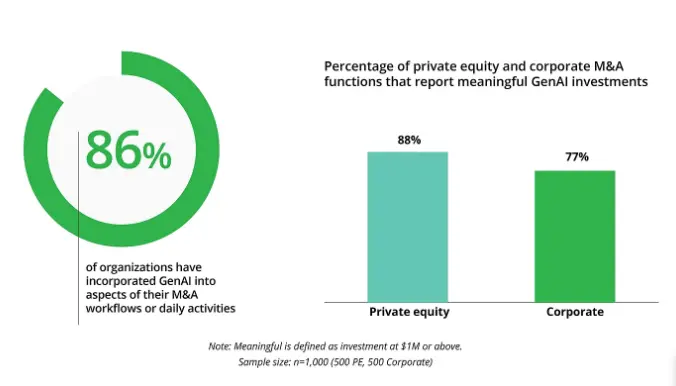
Source: 2025 M&A Generative AI Study | Deloitte US
Many firms still use AI technologies as a point solution — to scan diligence documents faster or to screen potential targets. But the real advantage emerges when AI supports the entire deal.
In this post, you’ll explore how artificial intelligence can help you to:
- Spot deals before competitors do
- Review documents and identify risks faster
- Make smarter pricing and deal decisions
- Keep integrations on track in real time
- Learn from each deal to improve the next one
The “5-layer AI M&A value stack”: Quick overview
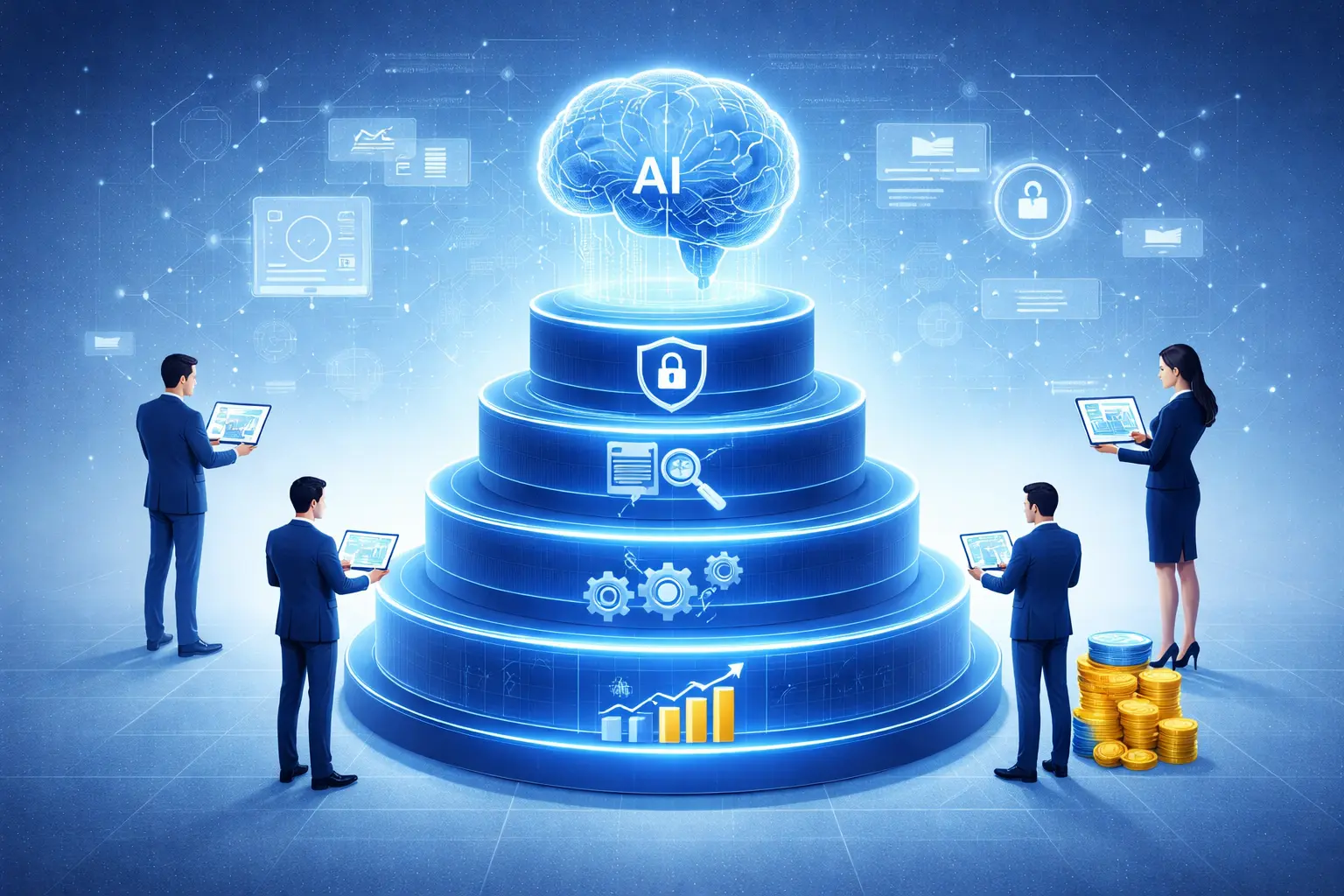
The stack works like a vertical value chain. Each layer builds on the one below it, expanding AI’s role from workflow acceleration to strategic advantage.
- Layer 1 — Intelligent origination. AI improves target identification by identifying companies earlier, scoring adjacency moves, and surfacing sell-side readiness signals before processes go live.
- Layer 2 — Cognitive due diligence processes. AI transforms document-heavy review into structured risk detection — accelerating contract analysis, financial anomaly detection, and cybersecurity exposure assessment.
- Layer 3 — Predictive deal engineering. AI shifts deal modelling from static spreadsheets to probability-weighted scenario forecasting — pricing synergies, churn risk, and cost-to-achieve with greater precision.
- Layer 4 — Autonomous integration. AI monitors synergy realization, flags operational drift, rationalizes systems, and surfaces organizational friction in real time.
- Layer 5 — Continuous value optimization. AI moves beyond “integration complete” into always-on performance monitoring — refining key performance indicators (KPIs), detecting churn early, and improving assumptions for future deals.
AI in M&A is evolving from a productivity enhancer into a strategic system that compounds advantage across transactions. The firms that connect these five layers will move faster, underwrite risk more accurately, and protect deal value long after closing.
Next, we outline each layer in detail.
Layer 1 — Intelligent origination: AI that finds deals before bankers do
Traditional sourcing uses networks, bankers, and static lists. However, teams may miss opportunities because of limited visibility and human bandwidth.
Artificial intelligence (AI) improves deal discovery by analyzing multiple data sources. It scans data to detect potential deals before they appear on the market. AI processes funding rounds, patent filings, hiring patterns, and online mentions. Combined with market mapping and buyer–seller matching algorithms, it helps teams identify attractive targets.
What “M&A AI tools” do here
Being data-driven and automated, they turn raw information into insights in the following way:
- Score targets based on strategic fit, growth potential, and financial health.
- Identify adjacency moves, uncovering opportunities that complement existing portfolios or products.
- Predict sell-side readiness, estimating which companies are most likely to consider a transaction soon.
AI technologies help identify promising opportunities and concentrate your efforts where they are likely to generate the greatest impact.
Example
A private equity firm is looking for new opportunities in health tech. They connect an AI platform to SEC filings, Crunchbase funding data, LinkedIn hiring trends, and industry news feeds. The system spots a small telemedicine startup showing growth and scores it as a good fit. The team reviews the insight and reaches out before other buyers notice the company.
What to ask your vendor
Before selecting an AI solution, clarify how it generates insights and how transparent they are. Ask software providers the following questions:
- Can the tool integrate multiple alternative data sources?
- Does it provide clear scoring or ranking logic?
- Can it surface adjacency opportunities in addition to obvious targets?
- Does it offer predictive insights on sell-side readiness?
These questions help ensure the platform supports proactive sourcing rather than automating traditional screening methods.
Layer 2 — Cognitive due diligence: The new standard for speed and risk control
Throughout the review process, teams must examine thousands of documents, verify financial information, and identify risks across legal, operational, and technical areas. Traditionally, this work relied on large teams manually reading documents.
AI is changing this model with a virtual data room at the center of this transformation in the business environment. It acts as a central hub with AI copilots where all deal documents are securely stored and organized for easy access. Data room copilots automatically summarize long documents, extract key clauses from contracts, and detect unusual patterns across financial and operational data.
Where AI detects risk in due diligence
Artificial intelligence becomes especially valuable when analyzing the key areas where risk may be hidden across thousands of documents, including the following:
- Legal and contract exposure. AI can scan agreements and extract important provisions such as change-of-control clauses, exclusivity terms, and unusual contractual obligations.
- Financial performance and revenue quality. Algorithms analyze financial statements and transaction data to identify inconsistencies, unusual revenue patterns, or customer concentration risks.
- Operational dependencies. The tool can map relationships between customers, suppliers, and internal processes, helping teams identify dependencies that may affect long-term stability.
- Cybersecurity exposure. In technology-driven acquisitions, artificial intelligence can assess the target’s attack surface, identify vulnerable systems, and evaluate third-party vendor risk.
With all these insights, teams can develop a more comprehensive picture of the target’s true position and the market conditions in which it operates.
Generative AI in M&A diligence
Generative AI adoption adds another layer of productivity to the diligence process. Instead of reviewing documents one by one, teams can generate structured outputs based on the information already analyzed by the system.
Common applications include the following:
- Initial Q&A list drafting. AI scans contracts, financials, and operational documents to suggest questions. This helps identify potential gaps early and focus on critical issues.
- Red-flag summary preparation. The system highlights unusual clauses, anomalies, and inconsistencies. These summaries allow you to review risks quickly without sifting through every document.
- Follow-up diligence question generation. Based on the initial analysis, AI proposes targeted questions to clarify unclear areas. This ensures the team covers all important points in advance.
- Integration risk identification. AI identifies overlaps, dependencies, and operational gaps. This helps anticipate challenges that could affect post-merger integration and take corrective action early.
These capabilities help teams transform large volumes of information into structured insights and keep diligence discussions focused on critical issues.
Nearly 80% of companies using generative AI in mergers and acquisitions report significant reductions in manual work.
Human-in-the-loop: Guardrails for AI-driven diligence
Artificial intelligence accelerates analysis, but people must still make final judgments. So, implement the following oversight measures that verify AI outputs and guide final decisions:
- Critical finding verification. Review key legal clauses and financial insights flagged by AI before drawing conclusions.
- Output cross-checking. Compare AI-generated summaries and extractions against original documents to confirm accuracy.
- Audit trail maintenance. Document AI analyses and decisions to ensure transparency and traceability.
- Judgment control. Ensure humans, not AI alone, finalize valuation or investment decisions.
Use AI as a reliable analytical assistant while keeping humans in control of critical decision-making.
Layer 3 — Predictive deal engineering: Turning diligence into deal decisions
Due diligence generates vast amounts of information. Therefore, translating it into actionable decisions can be slow and error-prone. Predictive deal engineering uses AI to move beyond static spreadsheets and models, allowing teams to forecast outcomes, quantify risks, and optimize deal structures with greater precision.
| Factor | How AI enhances it |
|---|---|
| Pricing analysis | Predicts optimal purchase price ranges based on historical deal trends and target performance. |
| Churn risk | Estimates the likelihood of customer loss or contract cancellations post-close. |
| Sales pipeline overlap | Identifies duplicate opportunities or conflicts between buyer and target sales pipelines. |
| Cost-to-achieve synergies | Forecasts integration costs and timelines required to achieve targeted efficiencies. |
By turning raw diligence data into probabilistic scenarios, artificial intelligence allows teams to anticipate challenges and make more evidence-based decisions.
Industry-tailored AI for M&A
Different industries present unique risks and considerations. To show how AI adapts to sector-specific patterns, we focus on two large industries.
AI in healthcare M&A evaluates regulatory compliance, models patient flow and capacity impacts, assesses reimbursement sensitivity, and flags potential operational bottlenecks in clinical and administrative workflows.
As Jeff Flaks, CEO of Hartford HealthCare, notes:
“This is the best time we’ve ever had in healthcare. You can get better, faster, now. The types of improvements we’re able to do with AI and machine-based learning and the ability to intervene quickly to make significant improvements is different today than ever before.”
AI in tech M&A analyzes codebase or product overlap, predicts talent retention and key personnel risks, evaluates intellectual property portfolios, and identifies technical or integration gaps that could affect product timelines.
These sector-specific modules enable more precise, context-aware, and predictive analytics. As a result, teams can assess complex markets faster and with greater confidence.
“Decision rooms” powered by AI
Decision rooms are structured environments where teams gather insights, run analyses, and make strategic choices. AI enhances the process by turning raw diligence and predictive analytics into actionable guidance. Specifically, teams can do the following:
- Produce faster IC memos by summarizing key diligence findings and scenario analyses automatically.
- Run scenario testing by comparing multiple deal structures, pricing models, and integration plans.
- Gain negotiation leverage by identifying areas where predicted outcomes create opportunities to optimize terms.
Predictive analytics combined with structured decision workflows allows teams move from reactive analysis to proactive deal shaping.
Layer 4 — Autonomous Integration: Where AI proves its ROI
Many deals fail to deliver expected value because integration challenges slow execution or erode anticipated gains. These challenges include operational misalignment, synergy leakage, and overlooked dependencies. AI transforms integration from a reactive process into an autonomous, insight-driven workflow. As a result, teams capture value faster and more reliably.
AI benefits in M&A integration
AI supports teams across multiple dimensions with the following outputs:
| Use case | How AI supports it |
|---|---|
| Synergy tracking dashboards | Monitors cost savings, revenue targets, and operational KPIs, highlighting deviations from plan. |
| Organizational design and role mapping | Suggests optimal team structures, identifies overlapping roles, and helps allocate resources efficiently. |
| IT and application rationalization | Analyzes systems and software overlap, recommending consolidation or retirement to reduce complexity and achieve cost reduction. |
| Change management signals | Applies sentiment analysis to detect early signs of cultural or operational friction through engagement and adoption metrics. |
According to a 2025 survey by McKinsey, 65% of respondents reported that AI provides more or improved insights into M&A deals. 42% said it simplifies or streamlines integration processes, reinforcing the tangible benefits of AI in post-close execution.
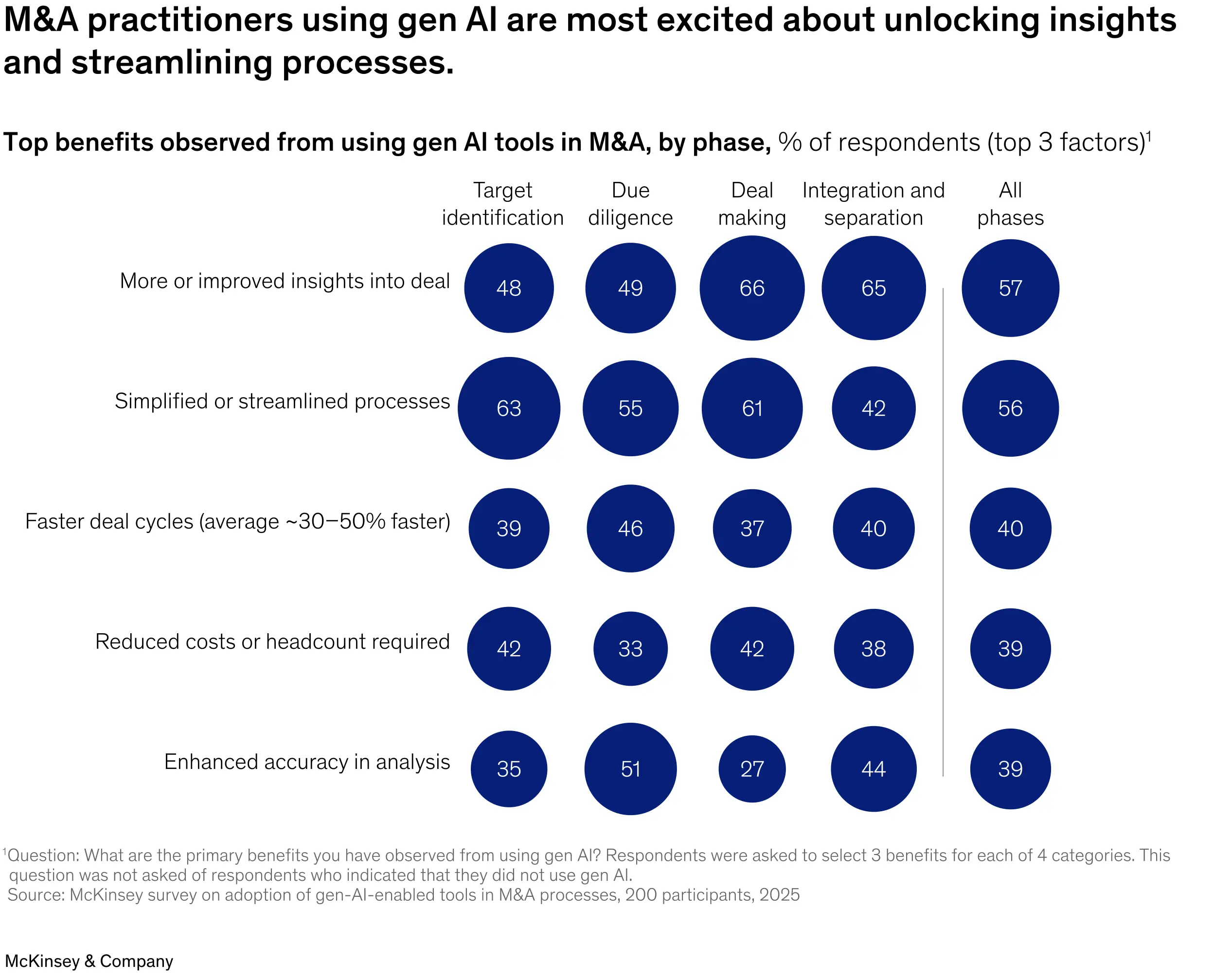
Source: Gen AI in M&A: From theory to practice to high performance | McKinsey
The AI payoff in M&A integration
Artificial intelligence delivers measurable benefits in M&A integration, making processes faster, more accurate, and more reliable. In particular, the following improvements give teams the confidence to capture synergies and manage risks effectively:
- Speed. KPI tracking, issue detection, and reporting occur in hours or days, letting teams act on insights quickly.
- Accuracy. Analysis of financial, operational, and HR data becomes consistent and reliable, reducing human errors.
- Fewer misses. Real-time flagging of risks, gaps, and deviations prevents overlooked issues from derailing integration.
- Faster decisions. Structured insights allow leadership to make informed choices on priorities, resource allocation, and change management.
These AI-driven improvements help teams capture the deal’s intended value and achieve integration goals efficiently.
How fast will AI pay off in M&A integration?
The speed and impact of AI in integration depend on the following factors:
- Deal size. Larger deals offer bigger potential gains but take longer to coordinate and implement.
- Integration complexity. Operations spread across divisions or locations benefit most from AI tools that visualize performance and clarify roles.
- Data maturity. Clean, structured data enables faster and more accurate insights.
- Operating model. Clear governance and reporting lines help professionals act quickly on AI recommendations.
- Cultural readiness. Teams open to M&A AI insights adopt recommendations more quickly.
AI delivers results faster when the deal processes are well-structured, data is mature, and dealmakers are ready to act on insights.
Additional resources: Recent M&A deals.
Layer 5 — Continuous value optimization: Post-close AI that keeps improving the deal
Even after integration is complete, capturing value remains an ongoing process. AI performs always-on monitoring, giving teams real-time visibility into performance and flagging risks before they escalate. This includes tracking KPIs for drift, spotting early warning signs of customer churn, and recommending adjustments to keep synergies on track.
At the same time, AI continues to learn from each deal. Data from closed transactions retrains predictive models, refines risk assessments, and highlights what worked and didn’t during integration. This continuous feedback, often called a governance loop, ensures that insights compound over time, making future M&A more precise, reducing risk, and helping teams capture greater value with every deal.
Example
A consumer goods company completed the acquisition of a regional competitor. AI dashboards continuously tracked sales KPIs and flagged a sudden drop in a key product line. At the same time, the governance loop analyzed integration outcomes from previous deals and recommended reallocating marketing resources to high-performing regions.
Acting on these insights, the team corrected the issue within days and protected the revenue.
AI in M&A gives teams a clear view of every deal, helping them find the best opportunities and spot potential risks before they become problems. It keeps integrations running smoothly, ensures synergies are realized, and tackles challenges in real time. AI learns and improves with every deal, making each next transaction faster and smarter.
The emerging “AI platforms for M&A” tool stack
AI platforms are becoming the backbone of modern M&A, connecting multiple tools into a single system that drives value creation and reduces risk throughout the deal lifecycle.
Each component of the stack plays a specific role in sourcing, diligence, integration, and post-close performance.
| Tool | How it works | Impact |
|---|---|---|
| Deal sourcing intelligence | Scans markets, public filings, news, and hiring activity to identify potential targets and score strategic fit. | Teams discover opportunities early and prioritize deals before competitors. |
| VDR + diligence copilots | Analyzes contracts, financial documents, and operational data; highlights risks and summarizes key insights. | Teams review information faster and identify risks before they become problems. |
| Cyber and IT risk engines | Assesses security exposures, IT system compatibility, and vendor risks. | Teams detect IT and security risks early and avoid costly surprises. |
| Integration command centers | Monitors KPIs, tracks progress, and flags operational friction in real time. | Teams keep integrations on track and capture expected synergies. |
| Post-close monitoring | Continuously tracks performance, detects KPI drift, churn risks, and feeds insights into future deals. | Teams spot issues early and improve results for future transactions. |
This stack of M&A software tools acts like a control hub for dealmaking, giving a complete view of the deal from start to finish and turning AI into a strategic partner.
Operating model: How to deploy AI for mergers and acquisitions without chaos
Successfully using AI in M&A requires a clear operating model that defines how new technologies fit into your team and processes. Key considerations include the following:
1. Build vs. Buy vs. Hybrid approach
Decide whether to develop AI capabilities in-house, purchase third-party platforms, or combine both approaches. Each option has trade-offs in speed, customization, and control.
| Approach | What It means | Pros | Cons |
|---|---|---|---|
| Build | Develop AI capabilities in-house. | Full customization, full control. | Slower setup, requires internal human expertise. |
| Buy | Purchase a third-party AI platform. | Fast deployment, proven tools. | Potential vendor dependency. |
| Hybrid | Combine in-house and third-party tools. | Balance of speed and flexibility. | Requires careful integration and governance. |
Whichever approach you choose, the key is to combine the best AI tools for due diligence in M&A and internal capabilities such as data governance, industry expertise, awareness of market trends, and clear deal-team workflows.
2. Data readiness essentials
Ensure materials are well-structured, securely accessible, and correctly labelled. Clean and organized data allows AI to produce reliable insights.
Checklist to ensure your data is AI-ready:
- Data is well-structured and consistent across sources
- Permissions and access controls are in place
- Taxonomy and labelling are standardized
- Sensitive data is secure and compliant
Gathering and organizing data from shared drives or email folders takes time and manual effort. A virtual data room for M&A securely structures and centralizes information, making it readily available for AI.
3. Defined roles
Assign responsibility for AI use and governance. Typical roles include the following:
- Deal lead oversees AI throughout the transaction, ensures outputs align with deal strategy, and documents decision authority clearly.
- AI product owner manages AI tools, monitors model performance, and controls user access to maintain integrity and accuracy.
- Legal reviewer validates compliance, reviews contracts flagged by AI, and focuses on sensitive documents to reduce legal risk.
- Cyber risk lead monitors IT and data security, enforces access controls, and maintains audit trails for accountability.
A clear operating model ensures AI supports deals effectively, avoids confusion, and drives insights across sourcing, diligence, integration, and post-close monitoring.
Risks, regulation, and trust: The deal team’s AI guardrails
Artificial intelligence in mergers and acquisitions must operate within safeguards. Specifically, teams should establish practical guardrails that protect sensitive information, maintain compliance, and ensure that AI outputs remain transparent and reviewable.
1. Cybersecurity and model leakage
Restrict integrations and monitor data flows to prevent unintended exposure of confidential information. Configure AI tools so that models do not retain or leak proprietary data used during analysis.
2. Bias in target selection
Regularly review model outputs and broaden training data to reduce bias in industry focus, geography, or company size. This helps prevent AI from narrowing the deal pipeline or overlooking strong targets.
3. Audit trails and reproducibility
Maintain detailed records of AI-assisted work. Log the data sources, prompts, models used, and reviewers involved so that insights can be verified during internal reviews or regulatory scrutiny.
4. The “no black-box valuation decisions” rule
Use AI to support valuation and strategic analysis, but require human validation for final decisions. Ensure recommendations remain explainable, documented, and confirmed by experienced deal professionals.
Leveraging AI responsibly is easy when teams set clear rules, use secure systems, and maintain human oversight.
Conclusion
Artificial intelligence changes mergers and acquisitions by making the whole process smarter and faster in the following way:
- First, it finds deals that humans might miss.
- Then, it checks the details quickly and spots hidden risks.
- Next, it helps decide the best price, structure, and strategy.
- After the deal, it keeps the integration on track and flags problems early.
- Finally, it learns from every deal to make the next one easier and more successful.
Start small and smart: run a pilot using AI in M&A due diligence and integration first. Test how it accelerates analysis, highlights risks, and keeps post-deal execution on track before scaling across the full M&A process.